The Korean Art of Clean Air at Home: How Affluent Koreans Create Beautiful, Breathable Living Spaces
In Seoul's most design-forward homes, air purification is not an appliance you hide in the corner. It is woven into the furniture, the lighting, and the living plants that make a home feel alive. Here is how Korean women create interiors that are as breathable as they are beautiful.
There is a particular kind of air in a well-kept Korean home. You notice it not because something has been added, a fragrance, a diffuser, a candle, but because something has been removed. The heaviness. The particulate fog of urban living that most of us have simply stopped noticing because we have never experienced the alternative.
Indoor air is frequently two to five times more polluted than outdoor air, carrying particulates from cooking, synthetic materials, cleaning products, and the invisible off-gassing of furniture and paint that accumulates in sealed spaces year-round. Korean women, particularly those in Seoul's densely populated urban districts, have understood this tension for decades. They have developed a philosophy of indoor air as considered as their approach to food and skincare. And the results, in both health outcomes and interior design, are unlike anything most Western homes have seen.
Why Indoor Air Quality Matters More After 40
As estrogen levels shift through perimenopause and beyond, the immune system becomes more reactive. Inflammatory responses that were once efficiently managed begin to linger. Skin that was once resilient becomes more sensitive to environmental triggers. Sleep, already more fragile in this life stage, is further disrupted by poor air quality during the hours when cellular repair is most active.
Research links chronic exposure to indoor particulates and VOCs (volatile organic compounds, the invisible gases released by synthetic materials, paints, and cleaning products) to accelerated skin aging, increased inflammatory markers, disrupted sleep architecture, and cognitive fog. These are not dramatic acute effects. They are the slow, quiet accumulation of a daily environment working against the body rather than with it.
This is precisely the kind of invisible factor Korean wellness culture addresses, not with alarm, but with elegant, practical design.
The Korean Approach: Beautiful Air as Interior Design
What distinguishes Korean air purification philosophy from the Western approach is not the technology. It is the integration. In most Western homes, an air purifier is a white plastic cylinder standing awkwardly in the corner of a bedroom, tolerated because it works rather than chosen because it belongs.
In Korean wellness homes, air purification is a design decision made at the same level as lighting or furniture. The appliance and the aesthetic are not in tension. They are resolved together, from the beginning.
1. Air Purification Built Into Furniture
One of the most striking developments in Korean wellness home design is the emergence of air purifiers integrated directly into furniture, side tables, console tables, bedside cabinets, and shelving units that contain high-performance filtration systems within their structure.
These pieces are indistinguishable from considered, high-quality furniture. A sculptural side table in pale oak. A low console in matte white with clean geometric lines. The air intake and output are designed into the form, discreet slots, perforated panels, integrated vents, so the piece reads as design, not appliance.
For women who have invested in their interiors, this matters enormously. A beautiful room should not be compromised by the practical objects it needs to function well. Korean design has simply decided it does not have to be.
2. Air Purification Within Lighting
Perhaps the most quietly extraordinary development is the air-purifying lamp, a floor lamp or pendant light that contains a fully functional HEPA filtration system within its body, operating silently while it illuminates.
For bedroom use, this approach is exceptional. The lamp you turn on every evening and off every night is simultaneously filtering the air during the hours when your body is most actively repairing itself. No additional appliance. No additional surface space. No visual intrusion.
The Vnitoz Plug-In Air Purifier is the accessible entry point into this category, compact, discreet, and designed to integrate into a room rather than interrupt it.
3. Indoor Plants as Air Architecture
No element of Korean indoor air philosophy is more beautiful, or more deeply cultural, than the role of living plants.
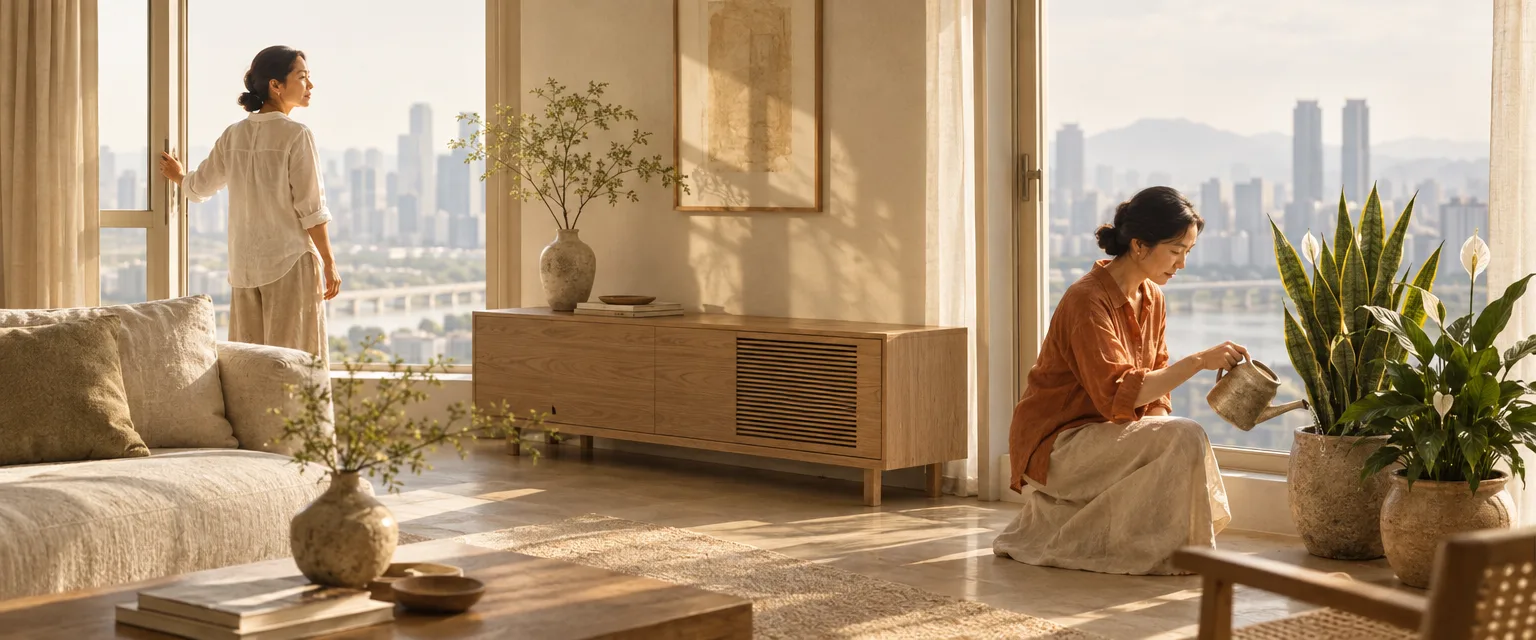
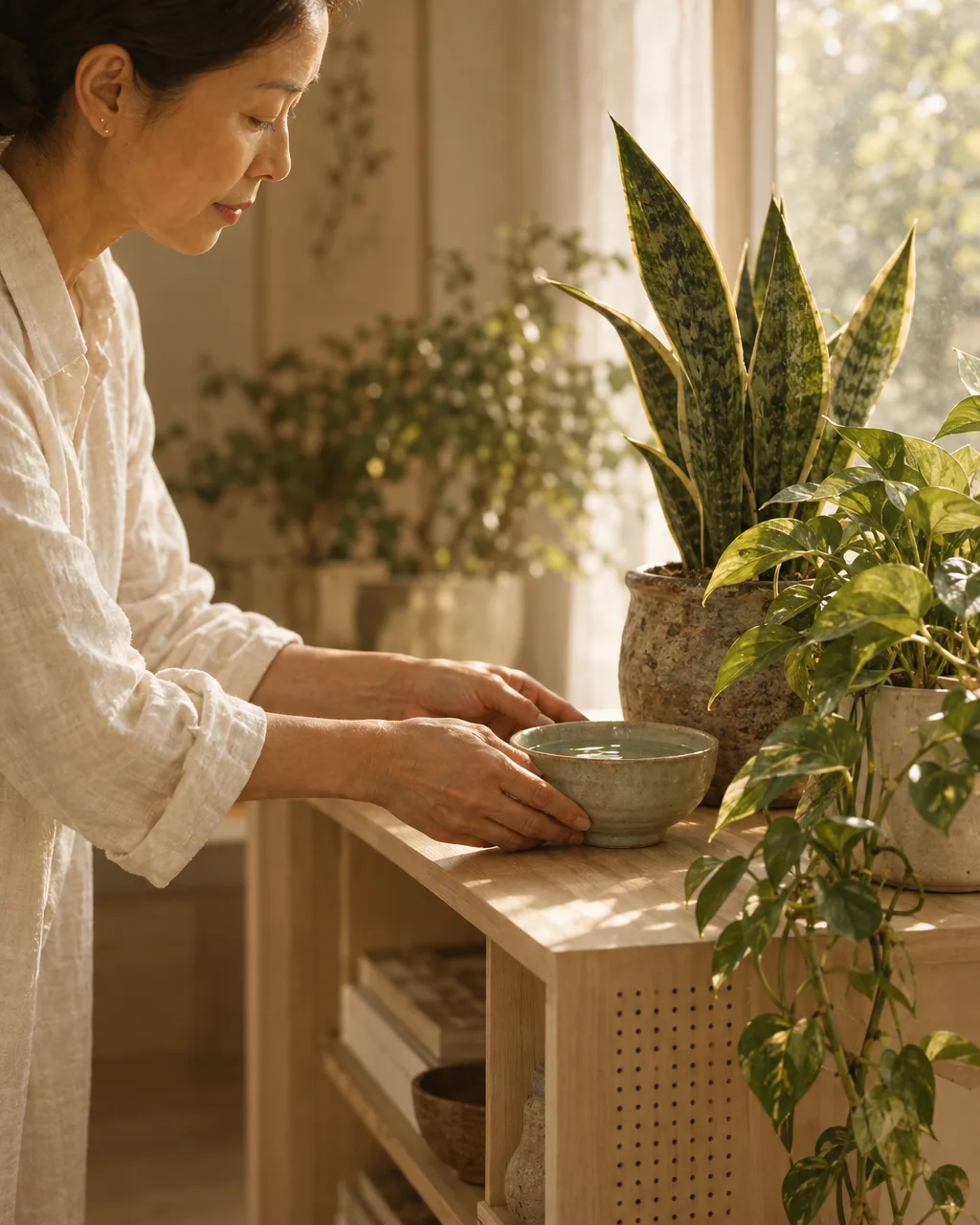
In a country where most people live in high-rise urban apartments, the relationship between Korean homes and living greenery is profound. Plants are not decorative accessories. They are environmental infrastructure, living filters that absorb carbon dioxide, release oxygen, and actively remove VOCs from the surrounding air.
NASA research identified golden pothos, snake plant, peace lily, and bamboo palm as among the most effective natural air purifiers, and Korean interiors have long treated exactly these varieties as living architecture, not windowsill decoration.
The concept of biophilic design, incorporating living nature into built environments to support human health, is embedded in Korean wellness home philosophy in a way that feels entirely natural rather than self-consciously trendy.
"In Korean homes, a living plant is never merely decoration. It is the room breathing."
The Barrina LH750 Indoor Greenhouse with Grow Light makes it possible to maintain a thriving indoor plant collection regardless of natural light conditions, a particular consideration for apartments and north-facing rooms.
4. The Coway Standard: What Korean Homes Actually Use
South Korea is home to Coway, a brand so embedded in Korean domestic life that it is often called "the mother of home appliances." Coway's air purifiers are found in the majority of health-conscious Korean homes, not as a luxury but as a standard household fixture as unremarkable as a refrigerator.
Coway's design language, clean, considered, architecturally minimal, reflects the Korean understanding that an air purifier should belong in a room. Their units are slim, quietly powerful, and designed to sit alongside quality furniture without apology. The Coway Airmega series has become the benchmark against which all other home air purifiers are measured for both performance and aesthetic integration.
The Air Purification Ritual: A Korean Framework
Korean air management follows a simple, instinctive rhythm that can be adopted immediately:
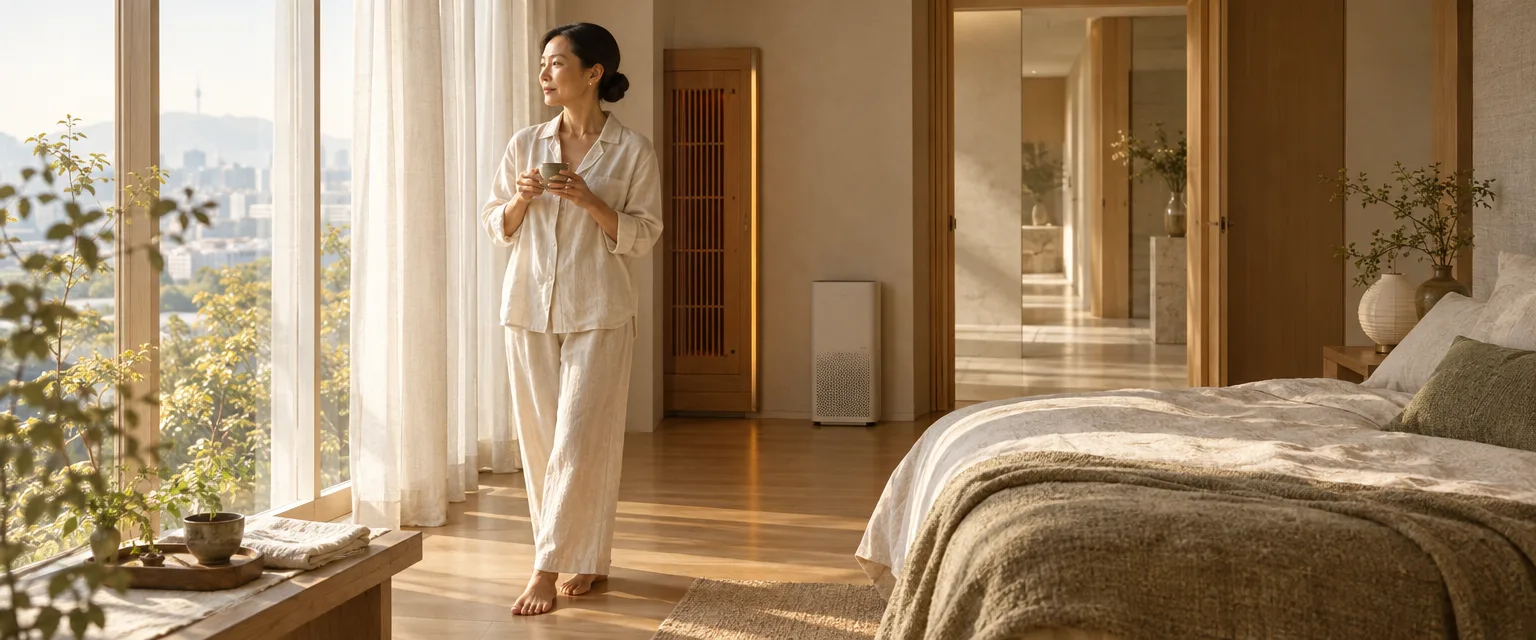
Morning: Open windows for 10–15 minutes regardless of season to exchange overnight air. Korean women call this 환기 (hwangi), and it is as automatic as making tea.
During cooking: Run purification actively. Cooking, even with clean ingredients, releases particulates and moisture that accumulate quickly in sealed spaces.
Evening: Activate the bedroom purifier or air-purifying lamp 30–60 minutes before sleep, allowing the room to reach optimal air quality during the hours of deepest cellular repair.
Seasonally: Clean purifier filters, refresh plant soil, and evaluate whether new green additions would benefit the space. Korean homes treat this as a seasonal ritual, not a maintenance chore.
Building Your Korean Air Environment
The Korean approach is not an all-or-nothing renovation. It is a series of considered, compounding additions, each one improving the environment you inhabit every day.
Begin with one quality air purifier in the bedroom, the room where you spend the most consecutive hours and where air quality has the most direct impact on sleep and skin repair.
Add two to three air-purifying plants to your living space. Golden pothos and snake plants are forgiving, beautiful, and among the most effective. Pair with a grow light if natural light is limited.
When ready, explore furniture-integrated or lamp-integrated purification for your main living areas, bringing the Korean design philosophy fully into your home without a single compromise to its aesthetic.
And practice hwangi daily. Open your windows every morning. It costs nothing and changes everything.
This Week's Seoul Ritual: Tomorrow morning, open your bedroom window for ten minutes before you do anything else. While it airs, make your tea, do your skincare, begin your morning. Then close it, and notice how the room feels differently for the rest of the day. This is 환기, one of the simplest and most underestimated daily practices in the Korean wellness home.
Next on Seoul Style Edit → The Korean thermal ritual that affluent Seoul residents are bringing home from the jjimjilbang, and why an infrared sauna in your own space may be the single most powerful longevity investment a woman over 40 can make.
Filed under 집Home as Medicine