Why Affluent Korean Women 45–65 Look Years Younger: The Long-Range Skin Strategy No One Explains
Korean women 45–65 don't just use better products. They operate a different system. Here is the prevention philosophy, the 5-layer daily ritual, the clinical maintenance sequence, and the lifestyle practices behind decades of remarkable skin.
What You'll Learn
- Why the typical K-beauty answer to this question misses the point entirely
- The three long-term biological targets Korean women prioritize from their 20s onward
- A 5-layer daily ritual framework designed specifically for mature skin 45–65
- What Korean women actually do in clinics and how treatments are sequenced over years
- The lifestyle practices that support the skin from the inside
- How to build your own version of this system without moving to Seoul
Subscribe to the Seoul Style Edit newsletter to receive the full Seoul Skin Project series, including our real-world treatment and lifestyle breakdowns for women 45–65.
The Real Reason Affluent Western Women Ask "Why Do Korean Women Look So Young?"
There is a version of this question that gets asked constantly and almost never answered well.
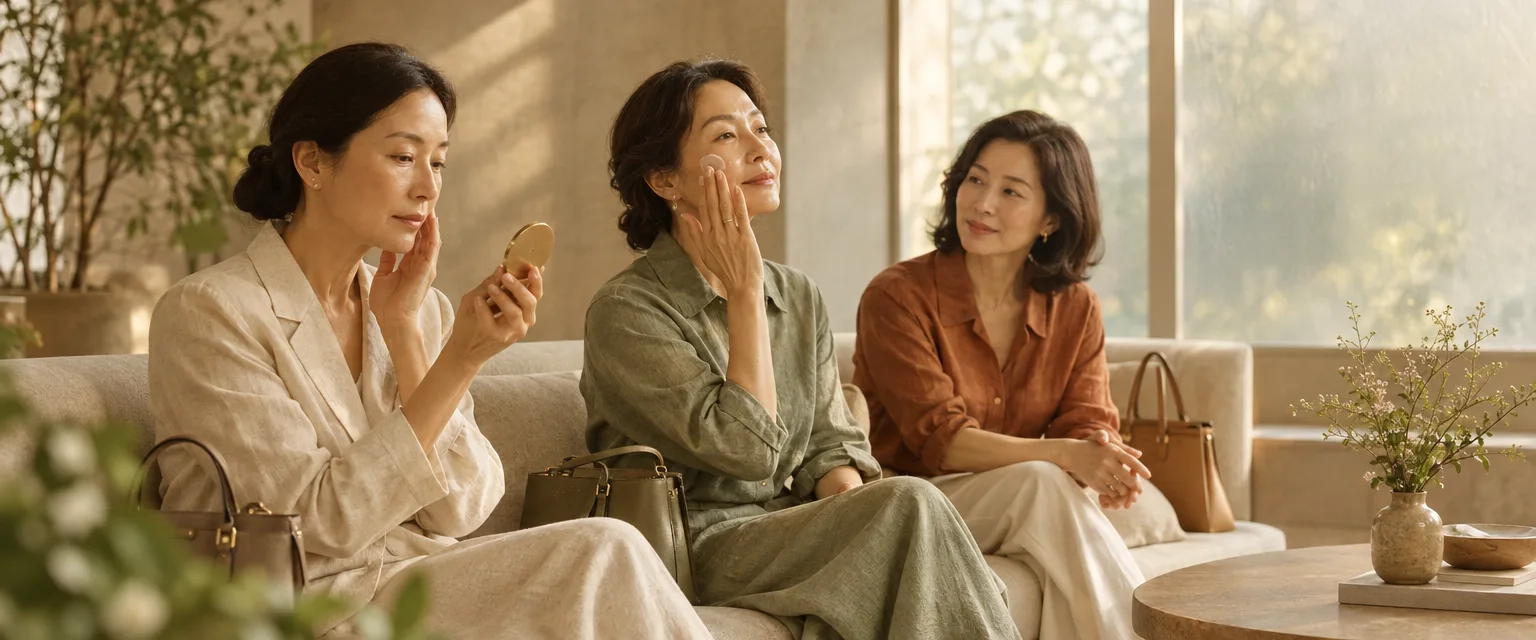
Why do Korean women 45–65 look the way they do? Not the 25-year-old K-drama actress. The 58-year-old woman at the clinic, the 62-year-old executive, the 70-year-old who looks genuinely, inexplicably well. What is the actual explanation?
The usual answers, glass skin routines, sheet masks, snail cream, are not wrong exactly. They are just answering a different question. They describe products. They do not describe a system. And what Korean women 45–65 have is a system.
Surface-Level K-Beauty Lists vs Real Long-Term Strategy
The 10-step routine became the dominant Western frame for understanding Korean skincare sometime around 2014, and it has been limiting the conversation ever since. It focuses on products and sequence. It does not address timing, prevention philosophy, clinical maintenance, or the lifestyle context that makes the products work in the first place.
A woman who starts a 10-step routine at 50 is not doing what Korean women do. She is using some of the same products but operating without the underlying strategy. The routine is not the point. The decades of consistent, targeted, prevention-oriented behavior behind the routine is the point.
What Affluent Women 45–65 Are Actually Looking For
The women who read Seoul Style Edit are not looking for product recommendations. They are looking for structure. They want to understand the prevention philosophy, the clinical options available to them, the lifestyle practices that compound over time, and the realistic trajectory of what good skin maintenance looks like across the second half of life.
That is what this article is for. Not inspiration. A framework.
Prevention Over Correction: How Korean Women Turn Skin Into a 30-Year Project
The single most important difference between Korean and Western approaches to skin aging is not an ingredient. It is a philosophy: prevention is always less expensive, financially, biologically, and aesthetically, than correction.
Korean women do not begin thinking about aging skin when they notice it aging. They begin in their teens and twenties, building habits that pay dividends at 45, 55, and 65. By the time a Korean woman reaches midlife, her skin has decades of consistent protection and maintenance behind it. The woman who looks remarkable at 60 usually started at 22.
This is not a secret that was hidden. It is simply a different cultural relationship with time.
Starting Early, Continuing Forever: Daily Habits That Pay Off at 45–65
Cultural observation and emerging clinical evidence: The foundational habits Korean women build early are not complicated. Daily SPF application, regardless of weather or season. Gentle, non-stripping cleansing that preserves the skin barrier rather than dismantling it twice a day. Consistent moisturization with barrier-supporting ingredients. These are not glamorous practices. They are infrastructure.
By midlife, a Korean woman with 25 years of consistent SPF use has meaningfully less cumulative UV damage than her Western counterpart who began taking sun protection seriously at 45. UV radiation is the single largest external driver of visible skin aging, responsible for the majority of wrinkles, pigmentation, and loss of elasticity that Western women often attribute to age alone. Prevention here is not a minor advantage. It is structural.
Collagen, Pigment, and Inflammation: The Three Long-Term Targets
Korean skincare philosophy does not frame aging as a single problem with a single solution. It identifies three distinct biological targets and addresses each one specifically.
Collagen preservation and stimulation: Clinical evidence shows that collagen production declines by approximately 1% per year after age 20, accelerating after menopause. Korean women use retinoids, peptides, and increasingly rejuvenating treatments to stimulate collagen production continuously rather than attempting to reverse significant loss after the fact.
Pigment control: Hyperpigmentation, sun spots, melasma, uneven tone, is addressed early and consistently rather than reactively. Vitamin C, niacinamide, and targeted brightening ingredients are daily staples, not occasional treatments.
Inflammation management: Clinical evidence links chronic low-grade skin inflammation to accelerated aging, collagen breakdown, and barrier dysfunction. Korean skincare emphasizes anti-inflammatory ingredients, barrier protection, and lifestyle practices that reduce systemic inflammation, including diet and stress management, as part of the skin strategy rather than separate from it.
The Mature-Skin Daily Ritual: 5 Functional Layers Instead of 50 Products
The 5-layer framework below is not a product list. It is a functional architecture: a way of thinking about what your skin needs daily and why each category of care exists. The specific products within each layer matter less than consistent execution of the layer itself.
Download the free Seoul Style Edit 5-Layer Mature Skin Planner to map your own daily routine and track your progress.
Download the 5-Layer Mature Skin Planner (PDF) ↓
Layer 1: Barrier First — Cleansers, Toners and Moisturizers for Sensitive, Mature Skin
The skin barrier, the outermost protective layer, becomes increasingly vulnerable with age. Estrogen decline after menopause reduces ceramide production, weakens the barrier, and decreases the skin's ability to retain moisture. Everything else in your routine works better when the barrier is intact.
Cleansing: Low-pH cleansers (pH 4.5–5.5) that match the skin's natural acid mantle. Double cleansing, an oil-based first cleanse to remove SPF and makeup followed by a gentle water-based cleanser, is standard Korean practice and prevents the over-cleansing that strips the barrier. Avoid foaming cleansers with sulfates, which are alkaline and disruptive.
Toning: Hydrating toners in Korean practice are not the astringents Western beauty used for decades. They are thin, water-based hydration layers, often containing hyaluronic acid, panthenol, or fermented ingredients, that prepare the skin to absorb subsequent layers more effectively.
Moisturizing: Ceramide-rich creams, barrier-repair formulations, and lipid-replenishing moisturizers are the foundation. For mature skin, richer formulations are appropriate day and night. The goal is not a dewy finish. It is a functioning barrier.
Layer 2: Brighten Without Burning — Vitamin C, Niacinamide and Ginseng for Spots and Dullness
Hyperpigmentation is one of the most common concerns for women 45–65, and it is one of the most addressable with patience and the right ingredients.
Vitamin C (L-ascorbic acid or more stable derivatives like ascorbyl glucoside): An antioxidant that neutralizes free radical damage, inhibits melanin production, and supports collagen synthesis. Applied in the morning under SPF, it amplifies sun protection while addressing existing pigmentation.
Niacinamide (Vitamin B3): One of the most well-studied brightening ingredients, with clinical evidence for reducing hyperpigmentation, minimizing pore appearance, improving barrier function, and reducing inflammation. Unusually well-tolerated across skin types, including sensitive and mature skin.
Ginseng: A cornerstone of Korean skincare with a long traditional history and growing research support. Emerging clinical evidence suggests ginsenosides, the active compounds in Korean red ginseng, may support skin elasticity, microcirculation, and antioxidant activity. In Korean skincare, ginseng appears in serums, essences, and moisturizers targeted specifically at mature skin concerns.
Layer 3: Firming and Rejuvenation — Retinoids, Peptides and Rejuvenating Actives
This is the layer most Western women approach incorrectly: either avoiding it entirely out of fear of irritation, or using it too aggressively and creating the barrier disruption that Layer 1 is designed to prevent.
Retinoids: The most evidence-backed category in anti-aging skincare. Clinical evidence is extensive and consistent: retinoids stimulate collagen production, accelerate cell turnover, reduce hyperpigmentation, and improve skin texture. For mature skin, low-irritation formats, retinol esters, encapsulated retinol, or prescription retinoids introduced gradually, are more appropriate than high-concentration formulas. Korean dermatologists typically introduce retinoids slowly, buffered with barrier-supporting ingredients, and used at night.
Peptides: Signaling molecules that communicate with the skin to stimulate collagen and elastin production. Less evidence than retinoids, but well-tolerated and complementary. Used in serums and moisturizers as part of a firming strategy.
Rejuvenating actives: Emerging evidence. South Korean dermatology clinics have been at the forefront of researching polynucleotide (PN/PDRN) treatments and exosome-based serums for skin rejuvenation. These are moving from clinic-only to at-home formulations. The evidence base is still developing, but the trajectory is promising enough that Korean dermatologists consider them part of the standard conversation for mature skin maintenance.
Layer 4: Daily Defense — Sunscreen, Shade and Pollution Protection Built Into Life
Korean women do not treat SPF as optional, occasional, or weather-dependent. It is applied daily, year-round, regardless of whether the day includes direct sun exposure. This is the single most impactful habit in the entire Korean skin strategy, supported by decades of clinical evidence on UV damage as the primary driver of visible aging.
SPF 50+ daily: Korean sunscreen formulations have led global innovation in texture and wearability, lightweight, non-greasy, often skin-tinted, specifically because Korean women expect to wear sunscreen as a final skincare step rather than a reluctant addition before outdoor activity.
Physical protection: Hats, parasols, and shade-seeking are not fashion accessories in Korean culture. They are recognized UV protection tools used without self-consciousness.
Pollution protection: Urban particulate matter accelerates skin aging through oxidative stress and inflammation. Antioxidant serums (Vitamin C, niacinamide) applied under SPF provide a meaningful second line of defense for women in cities.
Layer 5: Neck, Chest and Hands — The Zones Affluent Korean Women Refuse to Neglect
Cultural observation: In Korean skincare culture, the face does not end at the jawline. The neck, décolletage, and hands receive the same products, the same SPF application, and the same clinical attention as the face. This is considered basic, not exceptional.
These areas age on the same timeline as the face but are routinely neglected in Western skincare until the contrast between a treated face and an untreated neck becomes visible and difficult to address. Extending every layer of your facial routine to the neck and chest costs nothing additional. Not extending it is a long-term aesthetic cost that becomes expensive to correct.
Clinic Maintenance: Lasers, Skin Boosters and Lifting as Subtle Upkeep
The reason Korean women 45–65 look the way they do is not surgery. It is not one transformative procedure. It is consistent, gentle clinical maintenance over years: the dermatological equivalent of regular dental cleaning rather than emergency intervention.
South Korean dermatology clinics are among the most advanced in the world, and the cultural norm of regular clinic visits for maintenance rather than crisis response produces results that look like good genetics because the accumulation is gradual and the approach is preventive.
What Korean Celebrities and Affluent Women Really Do: Regular, Gentle Treatments
Cultural observation and clinical context: The treatments Korean women access regularly are not dramatic. They are maintenance procedures repeated at appropriate intervals.
Laser facials (low-energy, non-ablative): Address pigmentation, redness, and overall tone without significant downtime. Used monthly or bimonthly by many Korean women as a standard maintenance tool.
IPL (Intense Pulsed Light): Targets sun damage, broken capillaries, and uneven pigmentation. Appropriate for women 45–65 with cumulative UV damage and effective when used consistently over time.
Microneedling: Creates controlled micro-injury that stimulates collagen production. Often combined with PN/PDRN serums or growth factor solutions applied during the treatment to enhance rejuvenation.
Skin boosters (PN/PDRN, hyaluronic acid): Injectable or topical treatments that improve hydration, skin quality, and rejuvenation at a cellular level. Emerging clinical evidence for PDRN (polydeoxyribonucleotide, sometimes called salmon DNA) suggests meaningful improvements in skin texture and hydration with regular use.
Collagen-Boosting Treatments and Non-Surgical Lifts Sequenced Across Years
HIFU (High-Intensity Focused Ultrasound): Targets the SMAS layer, the same tissue addressed in surgical facelifts, stimulating deep collagen production and providing gradual, natural-looking lift over three to six months. Used annually or biannually by Korean women from their mid-40s onward as preventive maintenance, not correction.
RF (Radiofrequency) tightening: Heats the dermis to stimulate collagen remodeling. Used for skin laxity on the face, neck, and body. Results are gradual and cumulative.
RF microneedling: Combines the collagen stimulation of microneedling with radiofrequency energy delivered at depth. One of the most effective clinic options for skin texture, firmness, and pore refinement available to women 45–65.
The key to how Korean women use these treatments is sequencing and consistency: modest treatments repeated at appropriate intervals, rather than aggressive single interventions followed by long gaps.
The Lifestyle Under the Glow: Diet, Movement and Stress Rituals That Make Beauty Work
Topical skincare and clinical treatments work within a biological environment created by how you live. Korean skin strategy treats lifestyle not as a bonus but as the substrate: the conditions under which everything else either works or is undermined.
Fermented Foods, Balanced Meals and Low Sugar: Quiet Skin Insurance
Cultural observation and emerging clinical evidence: The Korean diet is rich in fermented foods, kimchi, doenjang (fermented soybean paste), ganjang, makgeolli, that support gut microbiome diversity. Emerging evidence links gut microbiome health to skin barrier function, inflammation levels, and skin conditions including acne and rosacea through what researchers call the gut-skin axis.
Glycation, the process by which sugar molecules bind to collagen and elastin fibers, degrading their structure and accelerating visible aging, is reduced by a lower-sugar diet. Korean cuisine is not zero-sugar, but it is structurally lower in the processed sugars and refined carbohydrates that drive glycation in Western diets.
Clinical evidence links chronic systemic inflammation, driven by diet, stress, and lifestyle, to accelerated skin aging, collagen breakdown, and impaired barrier function. The Korean dietary pattern, emphasizing vegetables, fermented foods, fish, and balanced macronutrients, is anti-inflammatory by structure rather than by design.
Walking, Stretching and Bathhouse Culture: Circulation and Emotional Calm
Cultural observation: Korean daily movement culture, habitual walking, stair use, hiking on weekends, light stretching, supports circulation in ways that directly benefit skin: improved nutrient and oxygen delivery, enhanced lymphatic drainage, and reduced cortisol levels.
The jjimjilbang (Korean bathhouse) deserves specific mention. Regular thermal bathing, heat exposure followed by cooling, has emerging evidence for improved circulation, reduced inflammatory markers, and stress regulation. Korean women use jjimjilbang not as a luxury but as a regular reset, and the skin benefits (improved circulation, reduced puffiness, enhanced glow) are considered a normal byproduct of a practice maintained for general wellness.
Chronic stress elevates cortisol, which degrades collagen, impairs the skin barrier, increases sebum production, and slows cellular repair. Korean cultural practices that regulate stress, community, ritual, structured rest, are skin practices in effect, even when they are not framed as such.
Build the daily walking habit that supports circulation, and your skin, with the free Seoul Walking Protocol Log.
Download the Seoul Walking Protocol Log (PDF) ↓
How Affluent American Women 45–65 Can Copy the System — Without Moving to Seoul
The Korean skin strategy is not culturally exclusive. It is a set of principles: prevention, consistency, layered maintenance, lifestyle support, that translate directly into any context. What it requires is structure and time horizon, not access to Seoul.
Build Your 5-Layer Skin Plan and Annual Treatment Calendar
The 5-layer framework in this article is your daily foundation. The annual treatment calendar is its clinical complement.
A basic annual calendar for women 45–65 inspired by the Korean approach might look like this:
Quarterly: One professional treatment, laser facial, IPL, microneedling, or RF, rotated based on skin concern and provider recommendation.
Biannually: One collagen-stimulating treatment, HIFU, RF microneedling, or a skin booster series.
Annually: A comprehensive skin assessment with a dermatologist or skincare specialist to evaluate trajectory, adjust your home routine, and plan the next year's clinical program.
This is not an aggressive schedule. It is a maintenance schedule: the difference between a car that is regularly serviced and one that is driven until something breaks.
The free Seoul Style Edit 5-Layer Mature Skin Planner helps you map your daily routine and annual treatment calendar.
Download the 5-Layer Mature Skin Planner (PDF) ↓
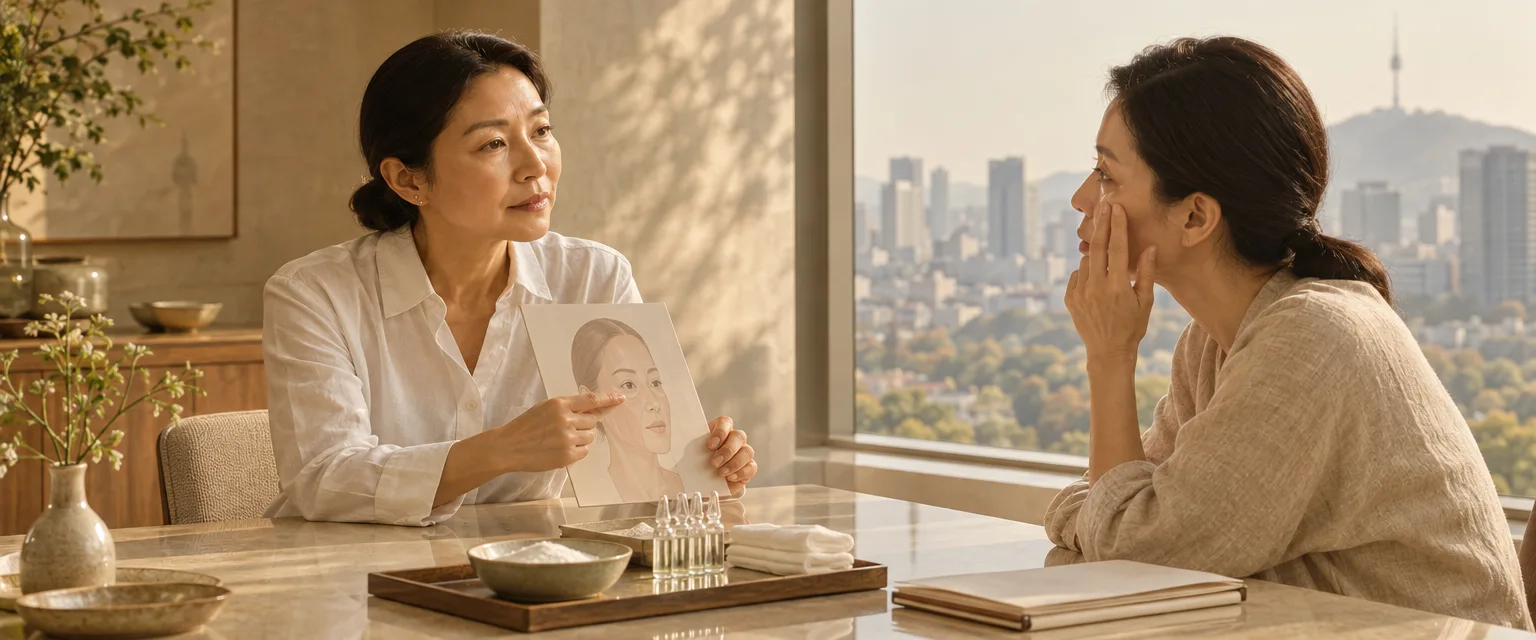
Talk to Your Dermatologist or Med Spa Like a Well-Aging Client, Not a Desperate Anti-Aging Patient
The language you use with your provider shapes the treatment you receive. "I want to look younger" invites a different conversation than "I want to maintain what I have and slow what I cannot stop." The second framing positions you as a well-aging client, someone with a long-term strategy, and tends to produce more thoughtful, proportionate recommendations.
Questions worth bringing to your next appointment:
- What is the current state of my collagen and skin barrier, and what should I prioritize this year?
- Which treatments address my specific concerns with the least downtime and the most sustainable results?
- How should I sequence treatments across the next 12 months?
- What in my current home routine is working, and what should change?
- What is your approach to prevention rather than correction for someone my age?
Frequently Asked Questions
Is it too late to start this approach at 50 or 60? No. The Korean approach is prevention-first, but it is not prevention-only. Women who begin consistent SPF use, barrier care, and retinoid use in their 50s see meaningful improvements in skin quality within months, and meaningful slowing of further deterioration over years. Starting later than ideal is categorically better than not starting.
Do I need to use Korean products specifically? No. The 5-layer framework is ingredient-based and principle-based, not brand-based. Many Western brands formulate excellent products across each layer. What matters is understanding what each layer is doing and why, and executing it consistently.
How long before I see results from this approach? Clinical evidence: Retinoids show measurable changes in approximately 12 weeks with consistent use. SPF prevents further damage immediately but reversal of existing damage is slower. Skin booster treatments show improvements within 4–8 weeks. HIFU results develop over 3–6 months as collagen remodels. The honest answer is: some things are fast, most things are slow, and all of them compound over time.
Are Korean clinic treatments safe for Western skin tones? Most treatments discussed in this article are appropriate across skin tones, though certain laser wavelengths carry higher risk of post-inflammatory hyperpigmentation in darker skin tones (Fitzpatrick IV–VI). This is a critical conversation to have with your provider before any laser treatment. Korean dermatology clinics have extensive experience treating Asian skin tones (Fitzpatrick III–IV) and the protocols developed there often transfer well.
How do I find a provider who understands this approach? Look for board-certified dermatologists or medical directors at reputable med spas who use language around prevention, maintenance, and skin health rather than transformation and reversal. The language of the provider tells you a great deal about their philosophy.
Elle's Edit: Where I Would Start
You do not need all five layers at once. If I were starting today, these are the three products I would reach for first. Each one belongs to a different layer, so you can begin with any of them and add the others whenever you are ready.
Beauty of Joseon Relief Sun: Rice + Probiotics SPF 50+ (Layer 4, Daily Defense). If you choose only one, choose this. Daily SPF protects everything else you do for your skin, and this is the sunscreen that makes it easy to love. Light, comfortable, and lovely under makeup.
Shop Beauty of Joseon Relief Sun on Amazon
Sulwhasoo Concentrated Ginseng Rejuvenating Cream (Layer 2, Ginseng). Ginseng has been at the heart of Korean skincare for generations, and Sulwhasoo is the brand affluent Korean women trust most. A rich, beautiful cream for mature skin.
Shop Sulwhasoo Ginseng Cream on Amazon
Rejuran Healer Turnover Ampoule (Layer 3, Firming and Rejuvenation). The at home cousin of the PDRN skin boosters mentioned above. A gentle way to bring the Korean clinic philosophy into your nightly routine.
Shop Rejuran Turnover Ampoule on Amazon
How to use all three: In the morning, sunscreen goes on as your last step. In the evening, apply the Rejuran ampoule first, then seal it in with the Sulwhasoo cream.
Elle's Perspective
I have been asked some version of this question more than any other since Seoul Style Edit launched. Why do they look like that? What are they doing?
The honest answer, which I find more interesting than any product recommendation, is this: they are playing a longer game. They started earlier, they maintained more consistently, and they treated skin not as a cosmetic concern but as a health practice with a decades-long time horizon.
The good news is that the game is still worth playing at any starting point. The skin responds to care at 50 and 60 and 70. The window for prevention is narrower than it was at 25, but the window for meaningful improvement and slowed deterioration is open for a long time.
The Korean approach does not promise you will look 35 at 60. It promises something more useful: that you will look like the best version of what 60 can look like, supported by a system that has been working on your behalf for years.
That is worth building. Start with one layer this week.
Filed under 재생Korean Longevity & Skin Rejuvenation