Meong: The Korean Art of Intentional Blankness and Why the Busiest Women in Seoul Swear by It
In Seoul, there is a word for the conscious practice of letting the mind go completely blank. It is called meong, and the neuroscience behind it is quietly rewriting what we understand about rest, restoration, and the cost of never stopping.
What You'll Learn
- What meong is and why it has no real Western equivalent
- The neuroscience of an unoccupied mind, and why doing nothing is genuinely restorative
- The specific meong rituals Korean women practice, from mul-meong to bul-meong
- How to build a meong practice into your week, no app or subscription required
The Woman Staring at Nothing
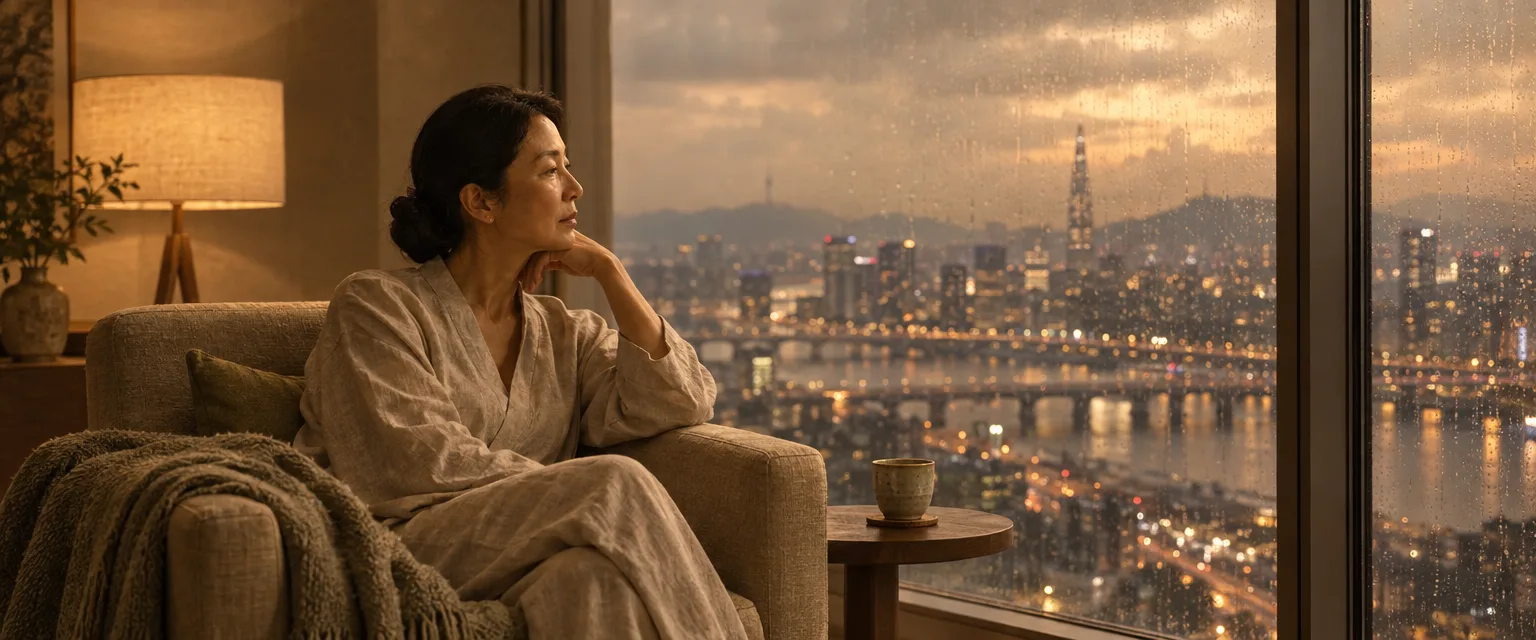
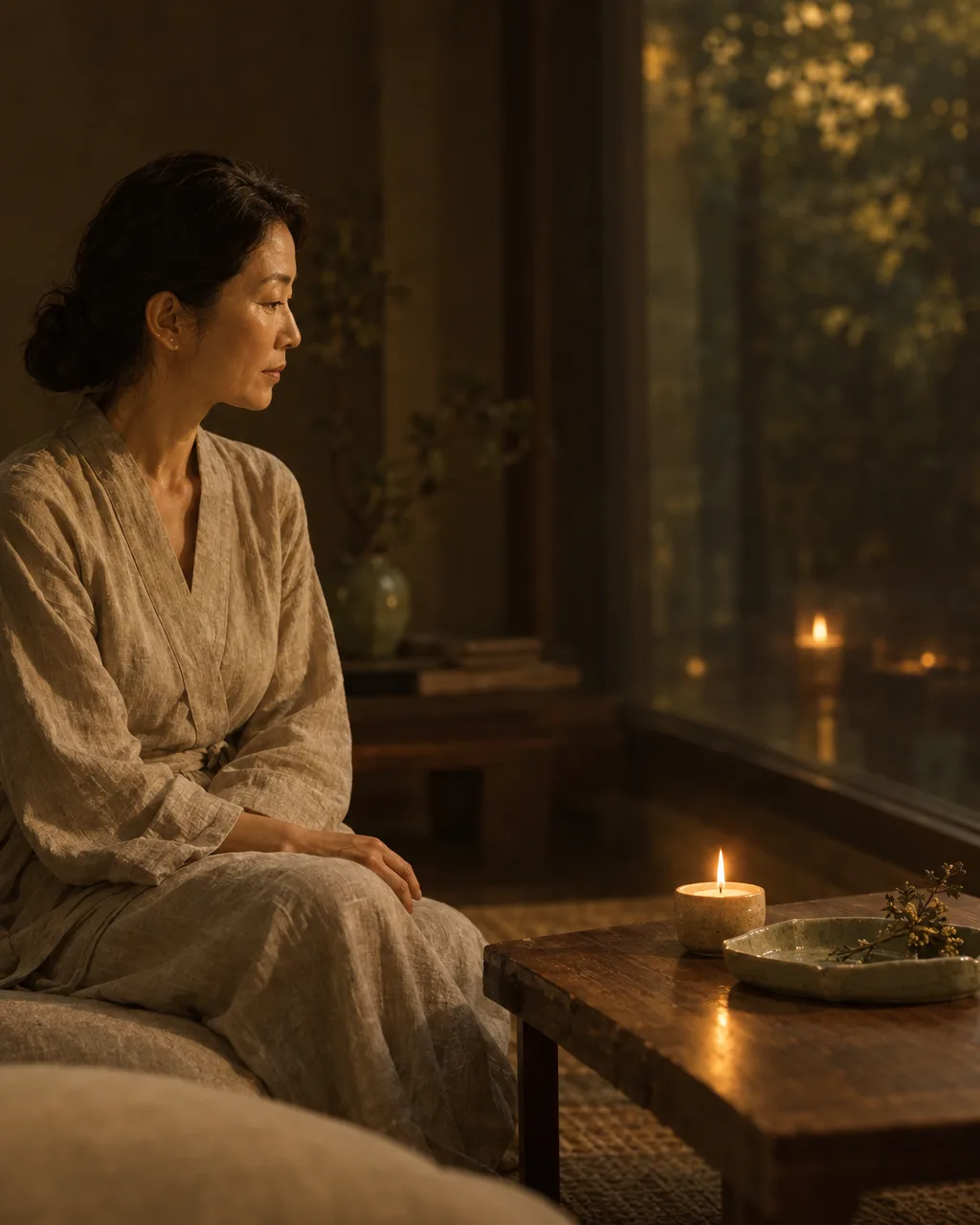
It's a Thursday evening in a high-rise apartment in Mapo. The city spreads below the window in a wash of lights. A woman in her late 50s sits in an armchair, a cup of barley tea cooling beside her. She isn't reading, or on her phone, or listening to anything. She's simply watching rain against the glass, her gaze soft and unfocused, somewhere between awake and absent.
Her family, if they walked in, wouldn't ask if she's all right. They'd recognize exactly what she's doing. In Korean, there's a word for it.
Meong (멍).
It translates loosely as "spacing out," but that loses something essential. In English, spacing out implies inattention, a failure to be present. In Korean, meong is something you do deliberately: conscious permission to let the mind go completely, beautifully blank. Not the effortful emptiness of formal meditation, but the natural drift that happens when you stop asking anything of yourself and simply exist inside a moment without agenda.
In Seoul, meong isn't considered a waste of time. It's considered maintenance.
Meong Inside Korean Daily Life
Cultural observation: To say someone is doing meong (멍 때리다, meong ttaerida, "hitting blank") isn't a criticism in Korea. It's an observation, often warm, of someone who has momentarily released the grip of productivity and allowed themselves to simply be.
Korean culture has named specific forms of meong based on the sensory anchor that facilitates the drift. Mul-meong (물멍) is staring at water: a river, rain against a window, the surface of a bath. Water's movement is visually complex enough to hold the eyes without demanding interpretation. Bul-meong (불멍) is staring into fire or flame, a fireplace or a small tabletop candle, often described as a winter ritual for evenings when the nervous system needs something that asks nothing of it. Haneul-meong (하늘멍) is sky-gazing, cloud watching without the intention of watching clouds.
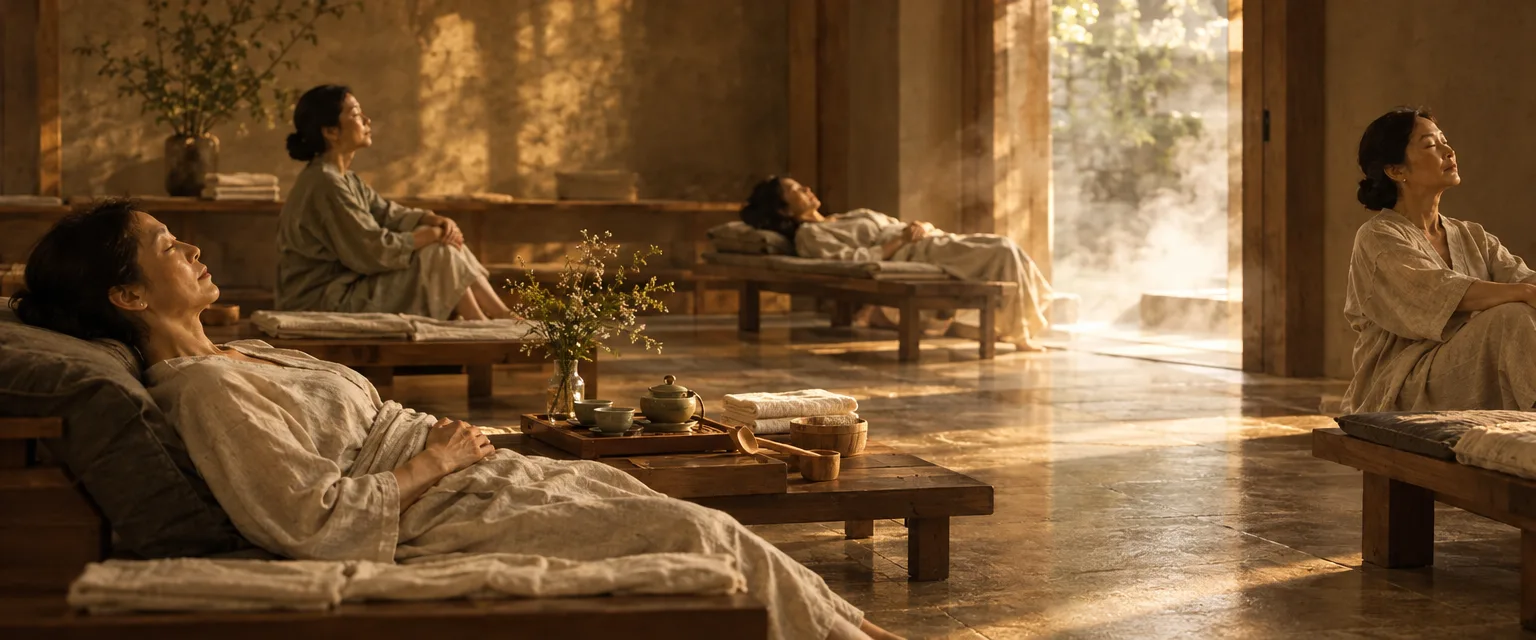
Cultural observation: In affluent Korean households, meong has become something close to a designed practice. Apartments are often oriented toward views specifically because a good window matters. Candles are kept on side tables not only for ambiance but for evening bul-meong. The bath is drawn not just for cleaning but for mul-meong. The practice is woven into the architecture of daily life rather than scheduled as a separate wellness event.
What's notable about meong, particularly compared to Western wellness culture, is how entirely it bypasses the performance of self-improvement. There's no app tracking your session, no guided voice, no measure of success. You're simply present with something that requires nothing from you, and in that space, something in the nervous system quietly resets. For women balancing demanding careers, families, and community responsibilities, meong asks nothing of them. That, for many, is exactly the point.
What Happens in the Brain During Meong
Clinical evidence: Neuroscientists have identified a network of brain regions, the Default Mode Network (DMN), that activates when the brain isn't engaged in a goal-directed task. For decades the DMN was considered the brain in idle, a background hum between more important operations. That understanding has shifted considerably. The DMN, allowed to operate freely, now appears central to memory consolidation, emotional processing, and the integration of experience into meaning. Suppressing it through constant task-switching and screen engagement has measurable negative effects on cognitive function and emotional regulation.
Emerging evidence: Research on the restorative effects of unfocused attention is still developing, but the direction is consistent. Studies of nature exposure, a context that tends to produce meong-like states naturally, have found that even brief periods of soft, undirected visual attention reduce cortisol and blood pressure, improve working memory, and restore attention capacity in people experiencing cognitive fatigue. The attentional quality meong produces, an outward gaze with low cognitive demand and no performance requirement, appears similar.
Emerging evidence: The habitual facial expressions associated with cognitive effort and social vigilance, the furrowed brow, the held jaw, the narrowed eyes of screen focus, involve sustained muscular contraction that over time contributes to visible markers of tension. Meong, by releasing the cognitive effort driving those expressions, may allow facial musculature to release in ways more active relaxation practices don't always achieve. This connection is observational and emerging rather than clinically established, but it's worth noting.
The unoccupied mind isn't a wasted mind. It's a mind doing something important it cannot do while occupied, something the pace of modern life rarely provides.
The Elle-Approved Meong Practice
No app. No cushion. No instruction. Here's how to begin.
Identify your meong anchor. Water is the most accessible: a window in rain, a running faucet, a bath. Flame is the most powerful for evening use, a single candle placed at eye level. The sky works beautifully in daylight from an unobstructed window.
Create a meong window in your week. Ten to twenty minutes is enough to feel the shift. Many women in Seoul practice meong in the transition moments of the day, after work before evening, after a bath before sleep, on a weekend morning before the day's demands arrive.
Remove the devices. This is the only real requirement. Meong cannot coexist with a phone within reach, because the phone will fill every silence the mind tries to create.
Release the agenda. You aren't trying to think about anything in particular, and you aren't trying to stop thinking. Thoughts will arrive. Let them drift. The drift is the point.
Notice what shifts. Most women report the first few minutes feel slightly uncomfortable, the edge of boredom before the release. Push through that edge. What arrives on the other side is quiet, and it's exactly what it feels like to stop performing and simply exist.
Frequently Asked Questions
How is meong different from mindfulness meditation? Mindfulness meditation typically involves deliberately directing and returning attention to a specific anchor, the breath, a mantra, a body scan. Meong asks for the opposite: a release of directed attention rather than its cultivation. Both are restorative, but they work through different mechanisms.
Can meong replace sleep or proper rest? No. Clinical evidence is clear that sleep is the body's primary restorative mechanism and cannot be substituted. Meong complements sleep by reducing the cognitive load and stress activation that impair sleep quality.
Is there an optimal time of day for meong? Cultural observation: Women in Seoul tend to practice meong at natural transition points, the end of the workday, after bathing, quiet mornings before the household wakes. Any ten-minute window where you can remove devices and introduce a sensory anchor will work.
Elle's Perspective
I came to meong late and somewhat reluctantly. The idea of sitting still and staring at a candle felt indulgent in a way I couldn't quite shake, which I now understand was exactly the problem.
What I discovered is that meong isn't indulgence. It's what you find on the other side of the discomfort of not performing. For women who've spent decades being productive, competent, and present for others, the experience of simply existing inside a quiet moment, with no output expected and no one watching, is more unfamiliar than it should be.
The candle is on my table most evenings now. I don't time it. I don't track it. I just let the flame do what flames do, and I let my mind do what minds do when you finally stop asking them to perform.
That's enough. It turns out, it's more than enough.
Disclosure: Seoul Style Edit occasionally includes affiliate links to products we have researched and believe align with our focus on evidence-based wellness and longevity. These are marked clearly and never influence our editorial content.
Next on Seoul Style Edit: The Korean Anti-Frailty Protocol: How Women Over 50 Stay Strong, Mobile, and Independent.
Filed under 마음Mind & Community