Designing Your Second Act: A Korean-Inspired Life Plan for Women Who Refuse to Age Small
Many Western women arrive at their 50s without a plan for what comes next. Korean culture offers a different model — one built on continued engagement, structured contribution, and the quiet conviction that the second half of life deserves as much design as the first.
What You'll Learn
- Why many Korean women approach the second half of life differently from their Western counterparts
- The research connecting purposeful engagement with healthy aging, cognition, and long-term independence
- How the Three-Track Second Act framework addresses health, contribution, and community together
- Why movement, meaningful roles, and social connection work as a system rather than separately
- Practical steps you can take this week to begin designing your own Second Act
What are Korean women doing differently that allows them to remain so purposeful, healthy, and socially connected decades after most Western women feel the structure of their lives beginning to quietly contract?
It is a question worth sitting with. Because the answer is not discipline. It is not genetics. It is not a supplement or a skincare protocol. It is something more fundamental, and considerably more replicable: design.
A Different Kind of Morning
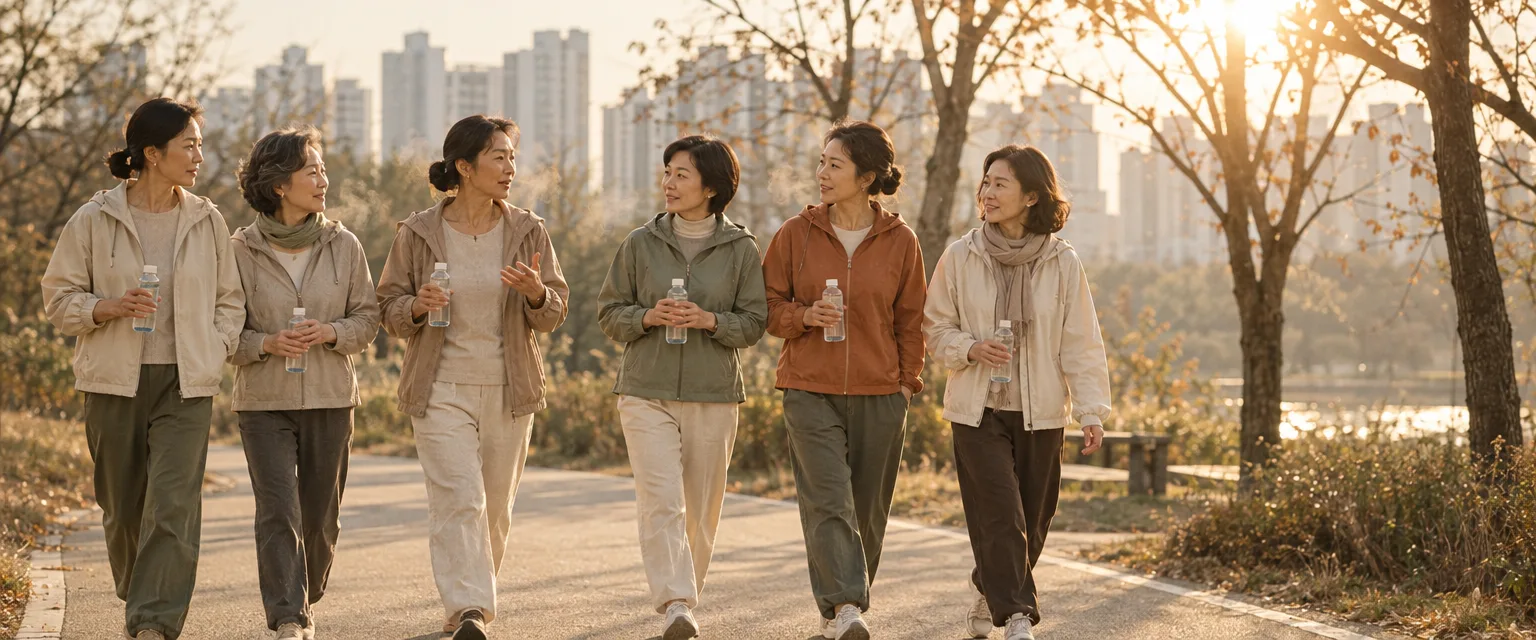
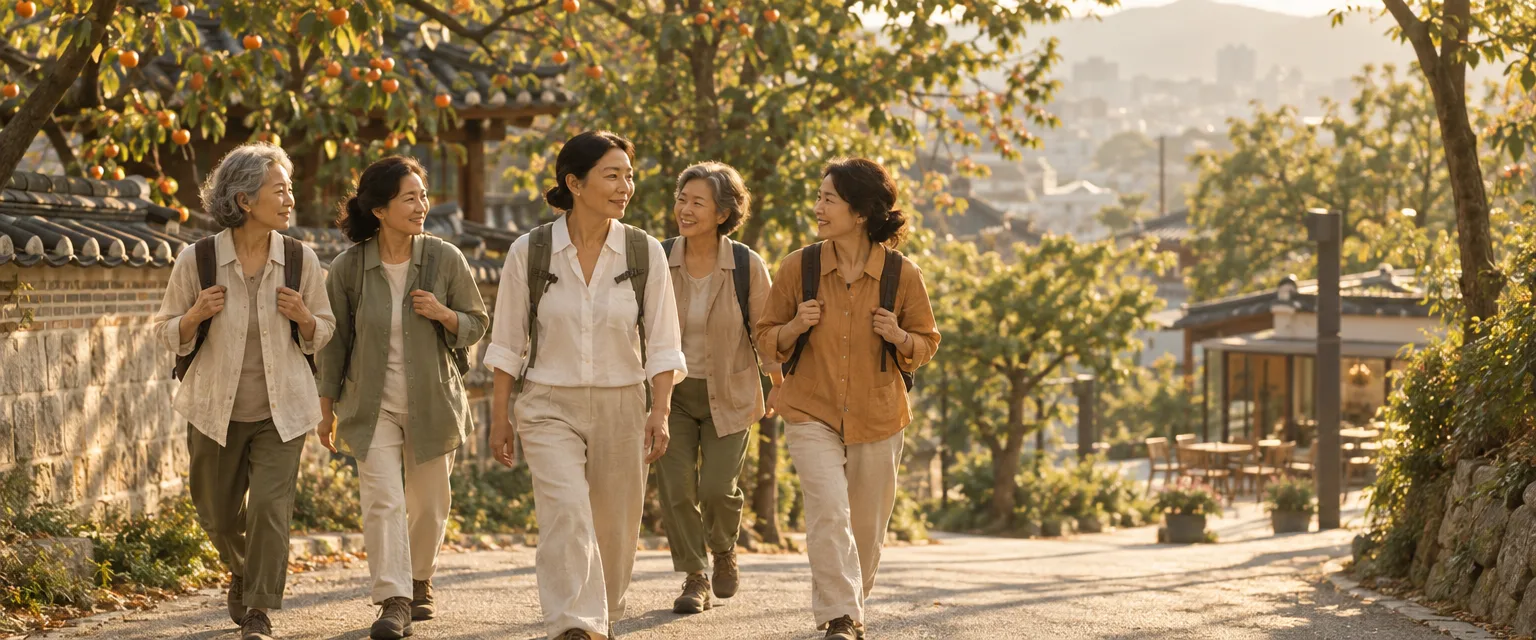
It is 6:45am in a residential neighborhood in Seoul. A woman in her late 60s finishes breakfast, pulls on her hiking shoes, and meets four neighbors at the end of the street. They have been walking together every weekday morning for three years. The route takes them up through a hillside park, past a temple, and back through narrow streets lined with persimmon trees. By 8:30am they are seated at a small café nearby, hands wrapped around cups of omija tea, the conversation moving easily between grandchildren, a documentary someone watched, and a health question one of the women wants to discuss with her doctor that afternoon. The café owner knows their orders. She asks after one woman's daughter by name.
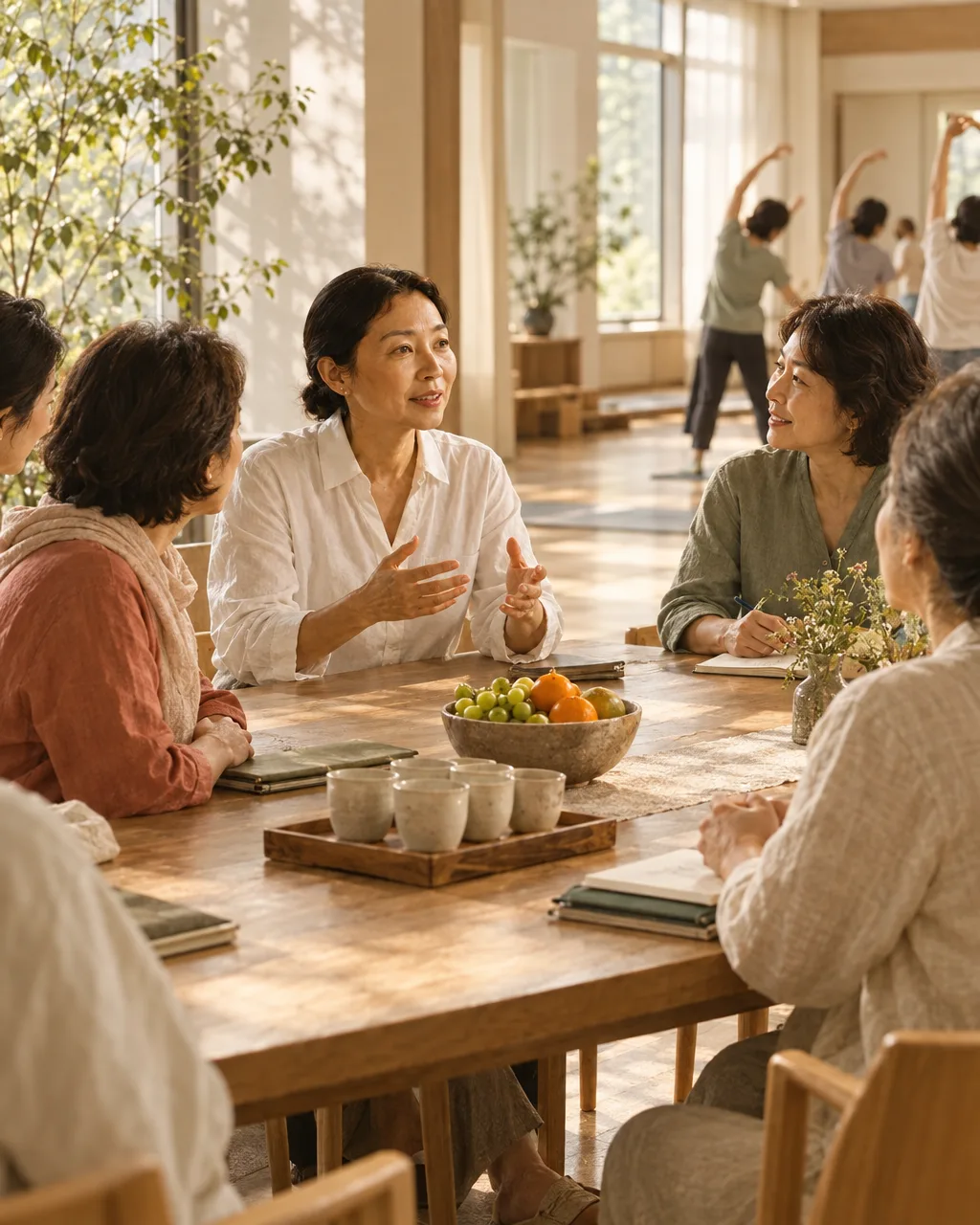
This is not a wellness retreat. This is a Tuesday.
By midmorning, a different woman in her early 60s is at the neighborhood senior welfare center four blocks from her apartment. She has been volunteering there twice a week since she retired from a career in education five years ago. Today she leads a conversation class for older adults who want to practice English. She stays for the communal lunch afterward, eating alongside a mix of women and men ranging in age from 58 to 84. The center's afternoon schedule includes a ceramics class, a fitness session with a certified trainer, and a lecture on Korean medicinal foods. Attendance is high. The center has a waiting list for some programs.
Later that afternoon, a woman in her mid-70s meets a younger colleague at a coffee shop in Mapo. She has been informally mentoring this woman, now in her early 40s, for two years. They review the younger woman's career plans, discuss a decision she is navigating, and make a plan to meet again next month. The older woman leaves with a quiet sense of having been useful. She will sleep well tonight.
Cultural observation: These scenes are not exceptional in South Korea. They are ordinary. What makes them worth paying attention to is not their ambition but their normalcy: the assumption, built into the social fabric, that women in their 60s and 70s remain genuinely active, engaged, and contributory. Not as an achievement. Simply as how life is structured.
Inside Korean Community Life
The following reflects cultural observation and available research on Korean social infrastructure. It describes general patterns, not universal experience.
To understand why Korean women in later life tend to remain so engaged, it helps to understand the systems they are embedded in.
South Korea has invested significantly in community infrastructure for older adults. According to data from the Ministry of Health and Welfare, there are more than 66,000 senior centers (경로당) and approximately 385 government-operated senior welfare centers (노인복지관) nationwide, with Seoul alone reporting more than 3,400 senior community halls. The welfare centers, operated by local governments, offer structured programming at low or no cost: fitness classes led by certified instructors, arts and crafts, language education, cooking classes focused on traditional Korean foods, cultural preservation programs, and organized social activities. Many also offer health screenings and connections to preventive care services.
These are not quiet, institutional spaces. They are active. Women arrive in groups. They exercise together, eat together, learn together, and leave with plans to reconvene. The accountability is social rather than formal: when you do not show up, people notice, and they ask where you were.
In many Korean apartment communities, this sense of collective rhythm extends into the building itself. Neighbors coordinate grocery runs. Rooftop gardens are tended communally. Evening walks happen in loose groups that form and re-form by habit rather than arrangement. The built environment is organized around the assumption that people will be present in each other's lives.
Beyond the centers, Korean social life for women in midlife and beyond is organized around what might be called accountability communities. Hiking clubs (등산 모임) that meet on weekends regardless of weather, with membership lists and group messaging threads. Neighborhood walking groups that depart at the same time each morning. Temple communities that combine spiritual practice with communal cooking, volunteer service, and shared meals. Alumni associations that meet not just for nostalgia but for ongoing mentorship and professional connection. Cultural preservation groups that keep traditional crafts, music, and food practices alive by transmitting them actively to younger generations.
After most of these activities, there is tea. Or a meal. Or both. The social time is not incidental. It is considered part of the practice.
Korean Perspective: The concept of jeong (정) is central to understanding why these community structures are so effective. Jeong refers to a deep relational bond that develops between people over time through shared experience, loyalty, and care. It is not simply friendship. It is something closer to a felt sense of belonging and mutual responsibility. Korean women in long-standing community groups often describe their relationships in terms of jeong: an attachment that makes showing up feel less like discipline and more like returning to something that holds them. Western wellness culture emphasizes individual motivation. Korean community culture relies on jeong. The difference in sustainability is significant.
This is the point Western readers often find most striking. Korean women are not more motivated than their Western counterparts. They are not more disciplined. They live inside systems and social structures that make engagement the obvious, expected, socially rewarded choice. Willpower is rarely required when the community is already waiting at the end of the street.
The Korean government has also developed what it formally calls "active aging" programs. The National Fitness 100 initiative provides fitness assessments and individualized exercise prescriptions through community centers and public health offices. Intergenerational mentorship programs, funded at the municipal level, pair older adults with younger professionals and students. Lifelong learning programs at universities and community colleges are specifically designed for adults over 50, with subsidized tuition and schedules built around the rhythms of later life.
The result is a system in which remaining engaged is the path of least resistance. The infrastructure is there. The social expectation supports it. The cultural norm is participation.
What the Research Says
There is a Korean word that does not translate cleanly into English: hwaldong (활동). It means activity, but carries the specific connotation of purposeful, productive engagement with the world rather than mere busyness. Korean culture has long treated sustained hwaldong as a basic condition of healthy later life.
The research increasingly agrees.
Clinical evidence: A landmark 2020 report from the Lancet Commission on dementia prevention identified social isolation and physical inactivity among the most significant modifiable risk factors for cognitive decline, with social isolation accounting for approximately 4% of dementia cases worldwide in their analysis. A separate body of research on what psychologists call "continued role engagement," the maintenance of meaningful social roles after midlife transitions, consistently finds associations with lower rates of depression, better functional health outcomes, and longer independent living.
Clinical Insight: A study published in the Proceedings of the National Academy of Sciences found that social isolation was associated with significantly elevated levels of inflammatory markers, including interleukin-6 and C-reactive protein. Chronic inflammation is one of the primary biological mechanisms underlying age-related disease. This means that the community structures Korean women participate in are not simply pleasant. They may be actively suppressive of the inflammatory processes that accelerate aging.
The effects extend beyond cognition. Chronic stress, social isolation, and loss of purpose influence sleep quality, hormonal balance, and systemic inflammation, the same biological processes that affect skin, posture, energy, and the visible markers of aging. Purposeful living is not separate from how women look and feel as they age. For many researchers, it is upstream of it.
The mechanism connecting social engagement to health outcomes is not fully understood, and researchers are careful to note that many studies in this area are observational rather than causal. What is consistent across multiple populations and study designs is the direction of the finding: women who remain genuinely engaged with work, community, creative practice, and contribution tend to age better across multiple measurable dimensions than those who do not.
The problem for many Western women is not motivation. It is structure. Korean culture provides a scaffolding of community, expectation, and routine that makes engagement the obvious choice. In many Western contexts, that scaffolding has to be deliberately built.
That is what the Three-Track Second Act plan is designed to help you do.
The Three-Track Second Act Plan
The following framework organizes a Second Act around three tracks that address the dimensions of engagement most consistently linked to healthy aging. The tracks are designed to work together: health creates the physical foundation, contribution creates meaning and cognitive engagement, and community creates the accountability and belonging that sustain both.
Track One: Health
Why it works
Clinical evidence: Preventive screening catches modifiable risk factors before they become conditions. Resistance training, specifically two or more sessions per week, is among the most evidence-based interventions available for preserving muscle mass, bone density, and functional independence in women over 50. The research on frailty, covered in depth in our Korean Anti-Frailty Protocol, makes clear that the loss of physical reserve capacity is one of the most consequential and most preventable risks of later life. Sleep quality directly affects metabolic health, cognitive function, and emotional resilience. Supplementation, when reviewed by a qualified practitioner, can address deficiencies that are common in midlife and have measurable effects on energy and cognition.
Korean women do not treat these as separate concerns. They treat them as a coordinated system, addressed proactively and maintained with the same consistency they bring to everything else.
Annual goal: Complete all age-appropriate preventive screenings. Establish or review relationships with a primary care physician, a gynecologist, and at minimum one specialist relevant to your personal risk profile. Have a current baseline on bloodwork (including inflammatory markers, metabolic panel, vitamin D, and thyroid function), bone density, cardiovascular health, and skin.
Quarterly focus: - Q1: Screenings and baseline establishment - Q2: Movement practice. Resistance training a minimum of twice per week. See the Korean Anti-Frailty Protocol and The Seoul Walking Protocol for the full evidence base. - Q3: Sleep and recovery audit. Assess sleep quality, address disruptions, and optimize your sleep environment. See our Home as Medicine pillar. - Q4: Supplementation and nutrition review with a qualified practitioner
Monthly ritual: One intentional movement experience that combines physical activity with social engagement: a group class, a walking date, a community hike. The social element is not optional. It amplifies the benefit of the physical practice.
Track Two: Contribution
Why it works
Clinical evidence: Research consistently finds that contribution to others, specifically occupying roles where others depend on your presence and expertise, produces health benefits that cannot be replicated by solo enrichment or leisure alone. The mechanism appears to involve both cognitive engagement (contribution roles demand active thinking, problem-solving, and communication) and what researchers call "role identity," the sense of knowing who you are and what you are for. Loss of role identity after major life transitions is associated with elevated depression risk and accelerated cognitive decline. Maintaining or rebuilding it through deliberate contribution is one of the most accessible interventions available.
Elle's Observation: In Korea, the transition from primary professional life does not typically mean the end of contribution. It usually means a shift in the form of it. The school principal becomes a neighborhood literacy volunteer. The corporate manager becomes a mentor to younger women in her field. The teacher becomes the person who keeps a traditional craft alive by teaching it. The contribution continues. Only the context changes.
Annual goal: Identify one contribution role you will actively occupy for the year. This is a specific commitment: a board seat, a mentorship arrangement, a teaching role, a leadership position in a community or professional organization, a regular volunteer commitment where your absence would be noticed and where you are genuinely needed.
Quarterly focus: - Q1: Identify and commit to the role - Q2: Establish its rhythms and relationships - Q3: Assess sustainability. Is this role asking of you in a way that feels generative rather than depleting? - Q4: Decide whether to deepen, shift, or add
Monthly ritual: One conversation with someone younger in which you share something you have learned. A mentee, a younger colleague, a family member. Articulating hard-won knowledge is both a contribution and a cognitive practice worth maintaining.
Track Three: Community
Why it works
Clinical evidence: Social connection influences health through multiple pathways simultaneously. It suppresses inflammatory markers associated with age-related disease. It provides what researchers call "social regulation" of stress responses, meaning that the presence of trusted others reduces the physiological impact of stressors that would otherwise generate sustained cortisol elevation. It provides cognitive stimulation through conversation, shared decision-making, and exposure to perspectives different from one's own. And it provides the accountability that makes every other health behavior more sustainable. Women with strong social networks exercise more consistently, sleep better, attend preventive screenings more reliably, and recover faster from illness.
Key Takeaway: Jeong (정), the Korean concept of deep relational belonging built through time and shared experience, is not a cultural nicety. It is a health asset. The relationships Korean women maintain through their hiking groups, community centers, and alumni associations represent decades of accumulated jeong. That relational depth is protective in ways that newer or more transactional social connections are not. Building your own version of jeong requires time, consistency, and choosing community structures you will actually return to.
Annual goal: Map your current social landscape honestly. Identify two or three relationships you are actively investing in, one community structure you belong to with regular accountability, and any significant gaps or relationships that have atrophied and matter to you.
Quarterly focus: - Q1: Relationship audit and intentional outreach to anyone you have been meaning to reconnect with - Q2: Community deepening. Increase investment in your primary group structure. - Q3: New connection. Make one deliberate effort to enter a community or context that is genuinely new to you. - Q4: Family and close-circle review. Assess the quality of your most important relationships and what they need from you.
Monthly ritual: One shared experience with a close friend that is not a meal. Face-to-face time, shared activity, and genuine conversation are the variables that matter. A walk, a class, a cultural visit, a new neighborhood. The experience does not need to be elaborate. It needs to be real.
The Three-Year Roadmap
This is an illustrative structure, not a prescription. Adjust every element to your actual life, health status, and priorities.
Year One: Foundation
↓
Build your health baseline. Establish resistance training. Join one community with real accountability. Accept one contribution role.
Year Two: Expansion
↓
Add community-based movement. Begin documenting your expertise. Travel or have one significant shared experience with a close friend or small group. Invest in one new community context.
Year Three: Integration
↓
Repeat comprehensive health screening and adjust proactively. Evaluate the legacy you are building through your contribution role. Host something. Create social structure, not just participate in it.
The goal of the roadmap is not to fill three years with activity. It is to ensure that at the end of three years, you have a health baseline that is current, a contribution role that matters, and a community that knows you well enough to notice when you are absent.
Frequently Asked Questions
Is this framework realistic for women who are still working full-time? Yes, with adjustments. Track Two (Contribution) may already be satisfied by your professional role, which frees capacity for Tracks One and Three. The primary risk for women who are still professionally active is neglecting Track Three. Social architecture tends to erode during periods of intense professional focus, and rebuilding it after the fact takes longer than maintaining it.
What if I do not know my purpose anymore? That is more common than most women admit, and it is not a signal that something is wrong. Purpose is rarely rediscovered through reflection alone. It is usually rebuilt through action: through showing up consistently for a contribution role, through re-entering a community, through the gradual accumulation of experiences that remind you what you care about. Begin with structure. Let meaning follow.
What if I do not have access to Korean-style community centers? The principle matters more than the format. Book clubs with genuine accountability, fitness studios with real community cultures, professional associations, volunteer organizations, faith communities, and alumni networks can all serve the same structural function. The question to ask is simple: would my absence be noticed?
How do I know if my contribution role is the right one? Three months of consistent participation usually gives a clear signal. Does your absence matter to others? Does showing up feel energizing rather than depleting? Are you learning something? If yes to all three, the role is worth continuing.
Is there an age that is too late to begin? Research on continued role engagement does not identify an upper age limit for benefit. Protective effects of social engagement and purposeful activity have been documented well into the 80s. Beginning at any point produces better outcomes than not beginning.
What You Can Do This Week
Do not attempt all three tracks simultaneously. Choose one action from the list below and complete it before the week ends.
- Schedule one preventive appointment you have been deferring. Put it in your calendar before you close this article.
- Identify your contribution role for the next 12 months. Write it down with enough specificity that you could describe it to someone else in one sentence.
- Contact one person you have been meaning to reconnect with. Suggest a specific activity: a walk, a class, a visit somewhere neither of you has been.
- Research one community structure in your area that meets regularly and involves genuine accountability. Note when it next meets.
- Read The Korean Longevity Mindset article if you have not yet. It covers the purpose research that underlies the framework in this article.
One action, completed this week, is the beginning of a Second Act. Everything else builds from there.
Elle's Perspective
There is a woman I think of often when I consider what a well-designed Second Act looks like. I met her at a community center in Seoul on a winter afternoon. She was 74. She had just finished leading a traditional papercraft class for a group of women in their 50s and 60s who were learning the practice for the first time. After the class, she stayed to eat lunch with the group, answered questions, and made a plan to bring a more difficult technique the following week.
She was not remarkable by Korean standards. She was simply present, useful, connected, and looking forward to next Tuesday.
That image stays with me because of what it does not contain. There is no performance of wellness in it. No optimization. No self-improvement project. Just a woman who has arranged her life so that it continues to require something of her, and who has found, in that requirement, something that sustains her.
Perhaps that is the quiet secret of Korean longevity. Not that women are trying to remain young. They simply continue building lives that remain full of people, purpose, movement, and contribution. And perhaps that is what allows them to age so beautifully.
Disclosure: Seoul Style Edit occasionally includes affiliate links to products we have researched and believe align with our focus on evidence-based wellness and longevity. These are marked clearly and never influence our editorial content.
Next on Seoul Style Edit: Eum-Yang Balance: Why Korean Women Protect Their Energy Differently and How You Can Too.
Filed under 의도Purposeful Living