The Korean Longevity Mindset: Why Purpose May Be the Most Overlooked Health Habit After 40
Purpose is not a personality trait. It is a measurable health variable — one that Korean women over 40 have long treated as seriously as diet or exercise. Here is the clinical evidence, the Korean model, and a four-part audit to apply it to your own life.
What You'll Learn
- Why purpose is increasingly recognized as a measurable predictor of healthy aging, not a personality trait or philosophical ideal
- How Korean daily life naturally supports purpose through community infrastructure, lifelong learning, and built-in contribution
- What current clinical research says about purpose, cognition, cardiovascular health, and longevity
- How to complete a practical four-part Purpose Audit to begin applying these principles this week
There is a variable that geriatric researchers have been tracking for decades that does not appear on most women's radar when they think about healthy aging. It is not a supplement, a protocol, or a treatment. It is purpose: a clear, self-identified sense of meaning and direction in daily life. Its relationship to healthspan is not philosophical. It is measurable, replicable, and increasingly well-documented.
Clinical evidence: A 2014 study by researchers Patrick Hill and Nicholas Turiano, published in Psychological Science, followed more than 7,000 adults over 14 years using data from the longitudinal Midlife in the United States (MIDUS) sample. Their finding: adults with a greater sense of purpose lived longer than their counterparts, independent of age, retirement status, and other markers of psychological wellbeing. The protective effect held across all adult age groups studied. A separate study from the Rush Memory and Aging Project, published in Archives of General Psychiatry (Boyle et al., 2010), found that greater purpose in life was associated with a significantly reduced risk of both Alzheimer's disease and mild cognitive impairment in community-dwelling older adults. Purpose has also been associated with reduced risk of stroke, better cardiovascular outcomes, lower rates of depression, and faster recovery from illness. In each of these cases, purpose appears as a primary predictor, not a side effect of something else.
What researchers define as purpose is specific: a sense that one's life has direction and meaning, that activities contribute to something beyond the immediate moment, and that there are goals worth pursuing. It does not require a grand mission. It requires a genuine one.
Dr. Carol Ryff, Professor of Psychology and Director of the Institute on Aging at the University of Wisconsin-Madison, has spent decades studying psychological wellbeing and its relationship to health outcomes. Her research framework, which identifies purpose in life as one of six core dimensions of psychological wellbeing, has been foundational to this field. Her work consistently finds that purpose in life, specifically the sense that one's efforts matter and contribute to something beyond the self, is a distinct predictor of health outcomes that cannot be replicated by other forms of enrichment or positive emotion alone.
Korean culture does not hand women a roadmap for purpose. But it provides a structural context that makes sustained purpose easier to maintain than in many Western settings. Understanding that context is where this article begins.
A Morning in Seoul: What Purposeful Aging Actually Looks Like
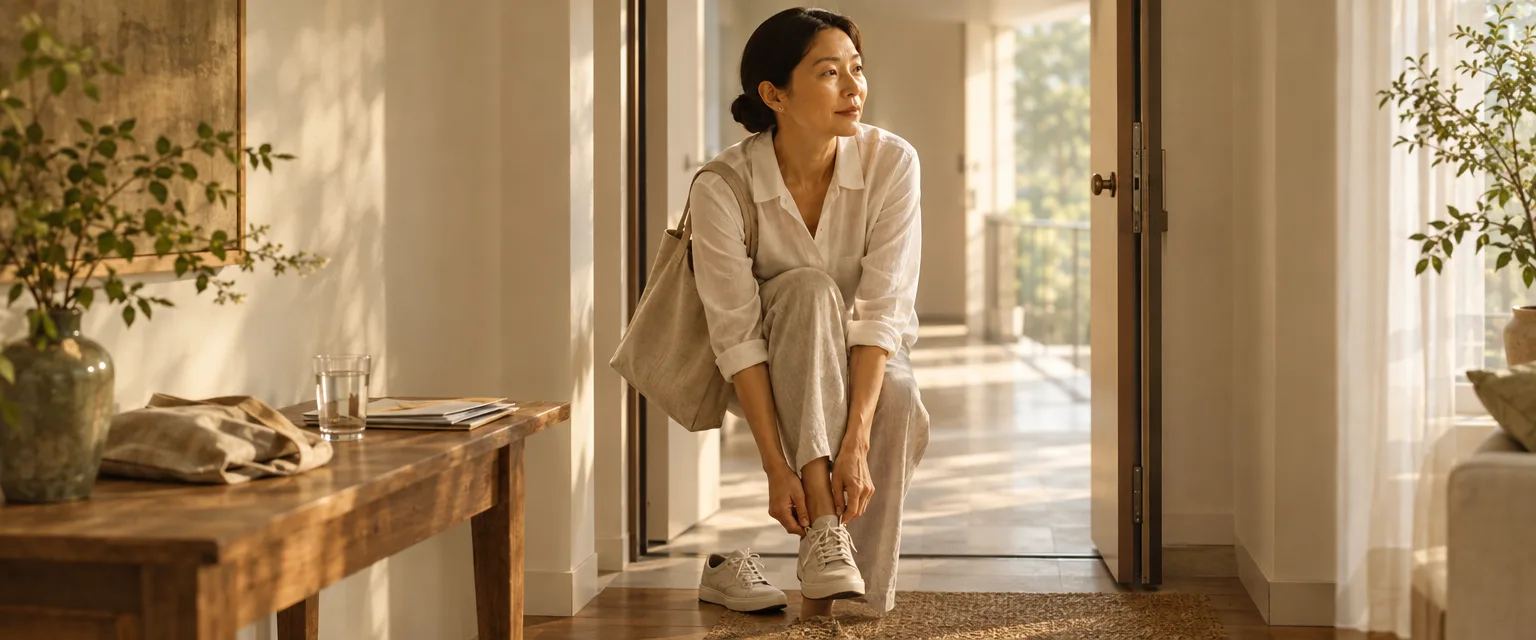
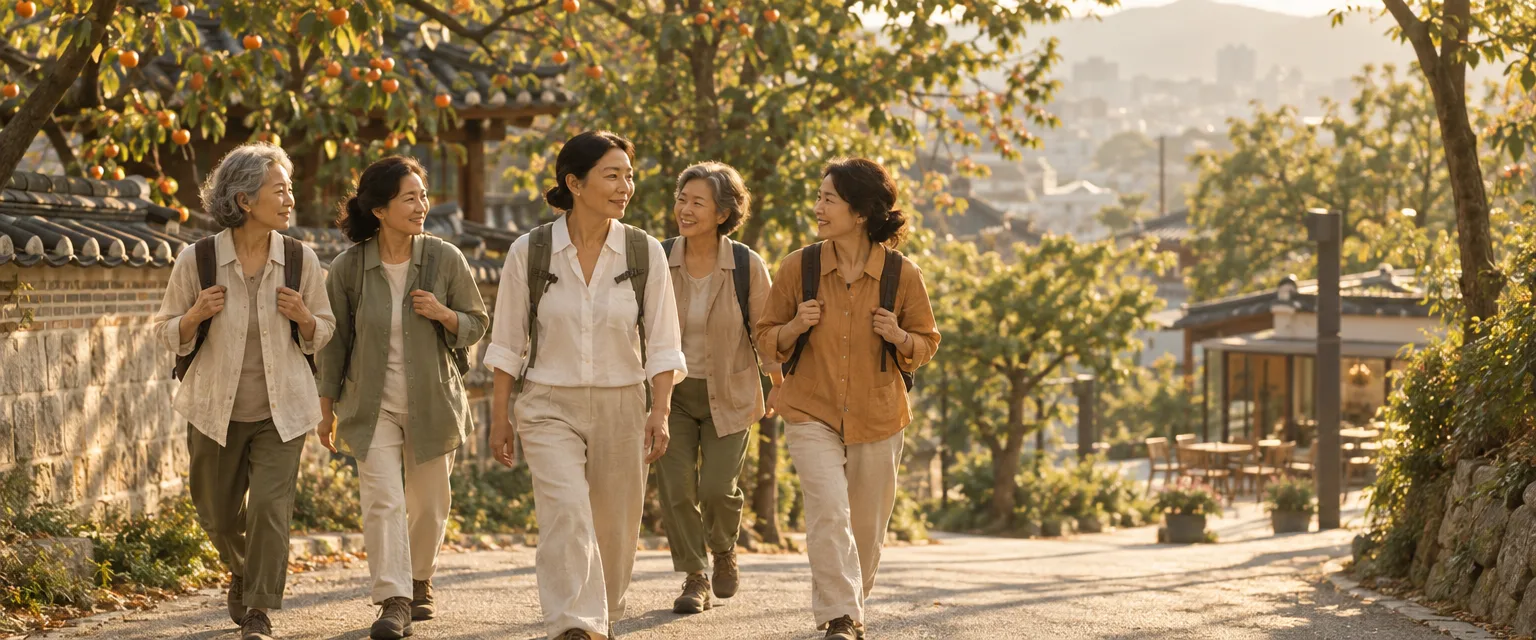
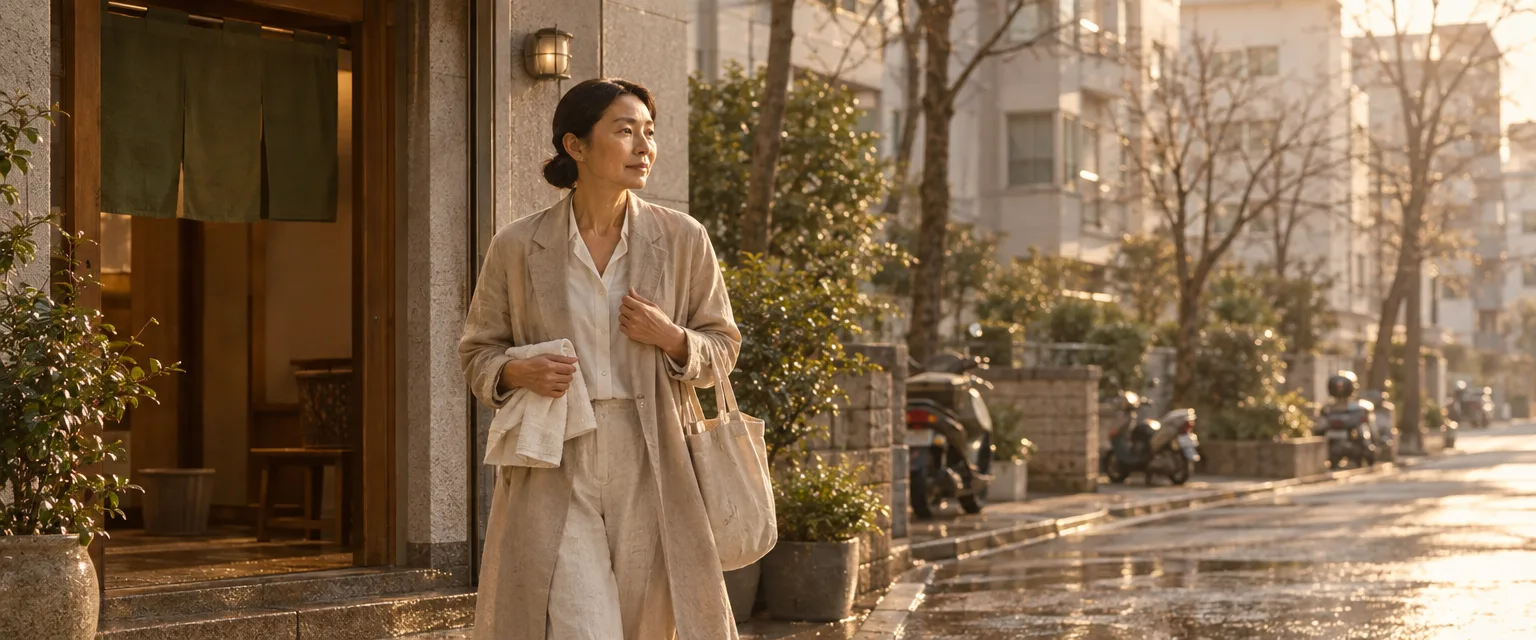
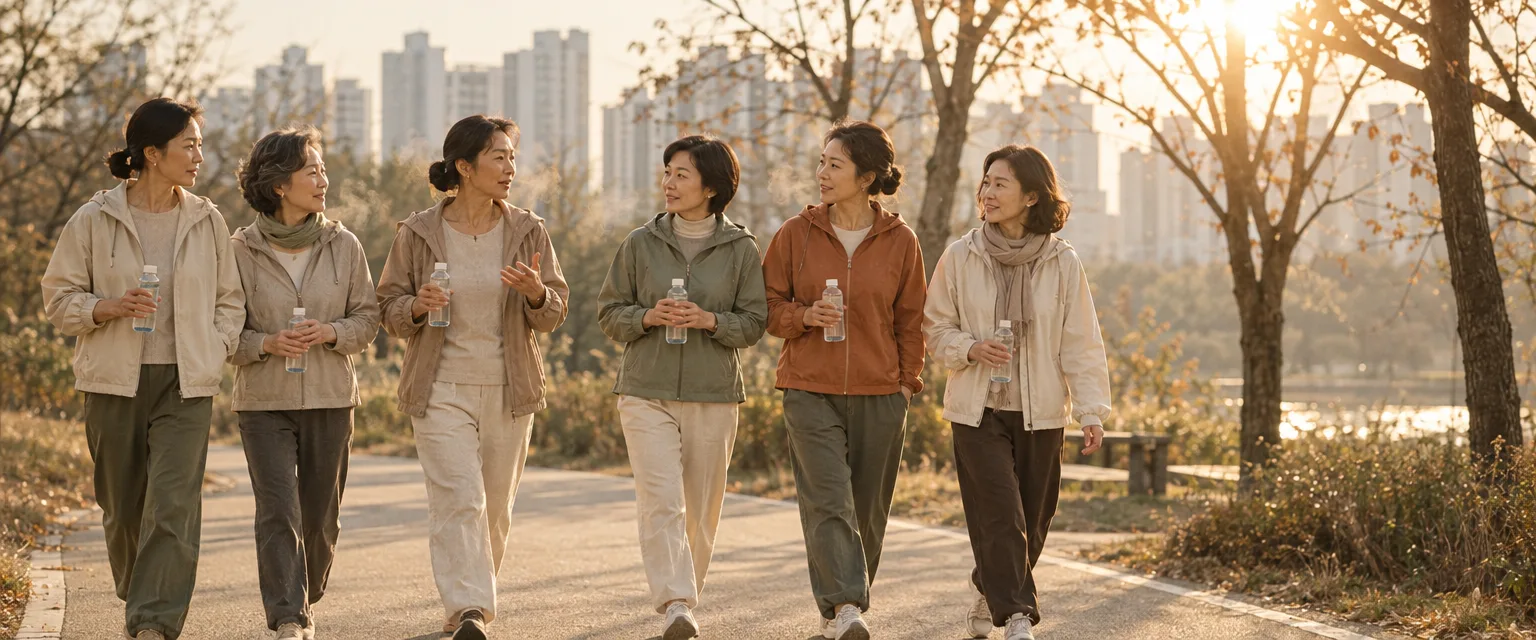
Picture a woman in her early sixties living in a residential neighborhood of Seoul. She wakes without an alarm, makes breakfast, and leaves the house by 8am to meet six neighbors for their regular morning walk through the local park. The walk takes forty minutes. The conversation covers grandchildren, a news story someone read, a health question one of the women wants to raise with her doctor. By 9:15am she is at the community center three blocks away, where she has attended a calligraphy class every Tuesday and Thursday for the past two years. At noon she meets a younger colleague for lunch, someone she mentors informally through a neighborhood intergenerational program. The afternoon is her own.
This is not a curated wellness retreat. It is an ordinary Tuesday.
Cultural observation: South Korea has one of the most extensive senior community infrastructures in the world. According to data from South Korea's Ministry of Health and Welfare, there are more than 66,000 senior centers (경로당) and approximately 385 government-operated senior welfare centers (노인복지관) nationwide, with Seoul alone reporting more than 3,400 senior community halls. The welfare centers, which are operated by local governments, offer structured programming at low or no cost in fitness, arts, language education, cooking, music, and community service, typically serving adults from their late 50s onward. Attendance is not stigmatized. It is expected. Showing up is what people do.
Beyond the centers, Korean social life for women in midlife is organized around activity-based groups with real accountability built in. Hiking clubs that meet every Saturday regardless of weather. Neighborhood walking groups with group chats and attendance expectations. Temple communities that combine spiritual practice with cooking, volunteer work, and regular meals together. Alumni associations that reconvene not just for nostalgia but for ongoing mentorship and connection. These groups are not casual. Missing a gathering has social consequence. Showing up has social reward. The structure creates the habit, and the habit sustains the purpose.
Korean culture has also historically valued what it calls uisik (의식): health consciousness as a way of living rather than a response to illness. Women in their 40s and 50s are expected to remain active, engaged, and contributing, not to withdraw. This expectation is not pressure in the Western sense. It is scaffolding. It makes continued engagement the path of least resistance.
Why the Structure Matters: The Science Behind the Korean Model
Here is where the research becomes specific, and where the Korean model earns its credibility beyond cultural observation.
Walking with others is not the same as walking alone.
Clinical evidence: Regular walking provides well-documented cardiovascular benefits: improved heart function, reduced blood pressure, better metabolic regulation. But walking with a consistent group adds a second, independent layer of benefit. Social connection has been associated in multiple studies with reduced inflammatory markers, better immune function, and significantly lower rates of cognitive decline. A 2023 meta-analysis in Nature Aging found that social engagement was among the strongest protective factors against dementia, comparable in effect size to physical activity. When Korean women walk together three mornings a week, they are not doubling up on one benefit. They are generating two distinct biological responses simultaneously.
Learning with others is not the same as learning alone.
Clinical evidence: Cognitive engagement, specifically active learning with a goal, has been consistently associated with reduced dementia risk and preserved executive function in older adults. But structured learning within a community setting adds social accountability, which increases consistency. Consistency is what produces the protective effect. The calligraphy class at the community center is not incidental to its health benefit. The class schedule, the instructor, the fellow students, are part of what makes the practice sustainable over months and years.
Contribution is not the same as activity.
Being busy does not produce the same health outcomes as being genuinely useful to others. This is perhaps the most important distinction in the entire body of purpose research. Dr. Ryff's work on psychological wellbeing identifies purpose in life, particularly the sense that one's efforts matter to others, as a dimension of wellbeing that is empirically distinct from life satisfaction or positive emotion. Korean culture builds contribution into its social structures almost automatically: the mentorship lunch, the volunteer role at the community center, the grandmother who teaches a grandchild a traditional recipe. These are not extras. They are load-bearing elements of a purposeful life.
What Korean Public Health Has Understood for Decades
Korean public health guidance: South Korea's National Health Insurance Service provides regular preventive screenings to all citizens, with programs for women that increase in frequency after age 40. The underlying philosophy is explicitly preventive: address risk factors before they become conditions. Korean women engage with their health proactively from early adulthood, a habit reinforced by both the healthcare system and cultural expectation.
The Korean government has also invested significantly in what it calls "active aging" infrastructure. The National Fitness 100 program provides fitness assessments and tailored exercise prescriptions through community centers nationwide. Intergenerational mentorship programs exist in many municipalities. Lifelong learning initiatives funded at the national level make education after retirement genuinely accessible, not aspirational.
The result is a system in which staying engaged is easier than withdrawing. The infrastructure exists. The social norms support it. The expectation is participation.
What Western women often encounter instead: In many Western contexts, midlife is a period of significant role transition without much structural support for redesigning what comes next. Children leave. Careers plateau or shift. The social architecture of earlier decades, school networks, work relationships, the connective tissue of a busy family life, changes shape. Without deliberate redesign, the result is often not dramatic decline but gradual contraction: fewer commitments, narrower routines, a life that is comfortable but quietly diminishing. Researchers call this "purpose erosion." It is common, it is measurable, and it is not inevitable.
The difference between the Korean model and the Western default is largely structural. Korean women are not more disciplined or more naturally purpose-driven. They live inside a system that makes engagement the obvious choice. Western women often have to build that system themselves. That is harder. But it is entirely possible, and this article is a practical guide for doing it.
The Four-Part Purpose Audit
The following framework draws on research in purpose and healthy aging, combined with the structural priorities visible in Korean daily life. It is not a personality exercise. It is a practical inventory.
Work through each section honestly. The goal is not to produce inspiring answers. It is to identify the gaps between where you are and where you want to be, and to make them specific enough to act on.
Part One: Roles
List every role you currently occupy: partner, parent, professional, friend, community member, caregiver, creative practitioner, learner.
For each role, ask: Is this role active and intentional, or has it become passive or habitual? An active role is one you are deliberately investing in with time, attention, and growth. A passive role is one you occupy in name but not in practice.
Note which roles feel most alive to you right now, and which feel depleted or unclear.
Part Two: Time Allocation
For one week, track how your waking hours are actually distributed. Do not estimate. Track.
Then compare your actual allocation to your roles and to what you identified as most alive. Most women find a meaningful gap between where their time goes and what they say matters most. That gap is structural information, not a character flaw. But it needs to be visible before it can be addressed.
Part Three: Habits to Drop
Identify two to three recurring activities that consume significant time and energy but contribute little to your sense of purpose, health, or connection. They may include:
- Passive media consumption that does not inform or restore
- Social obligations maintained out of inertia rather than genuine value
- Work tasks that could be delegated or discontinued
- Self-monitoring behaviors that do not lead to action
Start with reduce if drop feels too strong. But be honest about what is occupying space that could be used differently.
Part Four: Habits to Add
Four categories of activity have consistent evidence behind them in the context of purpose and healthy aging. Each one has a Korean parallel worth understanding.
Regular preventive care engagement. In Korea, scheduling screenings is considered a baseline expression of self-respect and long-term thinking. It belongs on your calendar with the same regularity as any other priority.
Structured learning with a community. Not passive content consumption, but active learning with a goal and other people involved. The community center calligraphy class is effective not just because of what is being learned, but because of who is in the room.
Contribution with accountability. A role, not an activity. Teaching, mentoring, organizing, volunteering in a capacity where your absence would be noticed. The accountability is not incidental. It is the mechanism.
Movement that is also connection. Two mornings a week of walking with a consistent group produces cardiovascular benefit, social benefit, and cognitive benefit simultaneously. The research suggests that when movement is social, all three are amplified.
This Week's Seoul Practice
Do not attempt all four at once. Choose one from the list below and do it this week with enough specificity that you could tell someone exactly when and where it will happen.
- Schedule one preventive appointment you have been deferring
- Call one friend and arrange a walking date for this week, not sometime soon
- Spend one hour learning something new in a structured context: a class, a workshop, a guided practice
- Remove one recurring obligation from your calendar that is maintenance rather than meaning
That is the Korean model in its simplest form: one intentional act, repeated reliably, compounding over time.
Frequently Asked Questions
At what age should I start taking purpose seriously as a health variable? The protective effects on cognition and cardiovascular health appear strongest when engagement is maintained consistently through midlife and beyond. Starting at 40 or 45 gives you decades of compounding. Starting at 60 still produces meaningful benefit. There is no wrong time to begin.
What if I genuinely do not know what gives me purpose right now? That is useful information, not a failure. Begin with the time allocation exercise, which often reveals what you are already gravitating toward, and the habits-to-drop section, which clears space for clarity. Purpose frequently follows structure rather than preceding it.
Does this apply if I am already highly scheduled and active? Scheduled and purposeful are not the same thing. Many women discover that their time is dense but not well-aligned with the roles and contributions that matter most to them. The audit is worth running regardless of how full your calendar appears.
What if I do not have access to Korean-style community centers? The principle matters more than the format. Book clubs with genuine accountability, fitness studios with real community cultures, professional associations, volunteer organizations, and religious communities can all serve the same structural function. The question to ask is: would my absence be noticed?
What is the minimum time investment to see benefit? Consistency matters more than quantity. One genuine contribution role, maintained reliably over months, produces more measurable benefit than multiple intentions pursued intermittently. Start smaller than you think you need to. Maintain it longer than feels necessary.
Elle's Perspective
I did not grow up with a framework for thinking about purpose as a health variable. Most of us did not. We were taught to think about what we wanted to do, what we were good at, what the market would pay for. The idea that having clear reasons to leave the house in the morning was a form of preventive medicine did not enter the conversation.
What Korean culture has shown me, slowly and through observation rather than any single insight, is that the women who age well are almost always the ones who remained genuinely useful. Not busy. Useful. There is a difference worth sitting with.
The woman leaving for her morning walk at 8am is not performing wellness. She is maintaining a life structure that keeps her cognitively engaged, physically active, and socially connected simultaneously. She built that structure over years of small, repeated choices. The four-part audit in this article is where that building begins.
It is not complicated. It is honest. And honesty is the part that requires something of us.
Disclosure: Seoul Style Edit occasionally includes affiliate links to products we have researched and believe align with our focus on evidence-based wellness and longevity. These are marked clearly and never influence our editorial content.
Next on Seoul Style Edit: Designing Your Second Act: A Korean-Inspired Life Plan for Women Who Refuse to Age Small.
Filed under 의도Purposeful Living