Eum-Yang Balance: Why Korean Women Protect Their Energy Differently and How You Can Too
Korean traditional thought has a word for the imbalance that drives chronic depletion: too much Yang, not enough Eum. Contemporary stress research calls it the same thing in different language. Here is how to design a week that actually restores you — and why that is one of the most underrated longevity strategies available.

What You'll Learn
- Why health-conscious Korean women structure their weeks so differently from most Western women
- The traditional Korean concept of Eum-Yang and how it shapes daily rhythms, rest, and recovery
- What current research says about chronic stress, cortisol, and the biology of depletion
- How to design a week that genuinely restores you, using a practical template rooted in Korean daily life
- The early warning signs that your week has drifted out of balance, and simple corrections for each
Why Do Korean Women Seem So Rested?
It is a question many Western women find themselves asking, sometimes while scrolling past images of Seoul, sometimes while sitting across from a Korean colleague who seems to move through a demanding week with a composure that feels almost unfamiliar.
Why do health-conscious Korean women so often seem calmer, steadier, and less depleted than their Western counterparts, even when their lives are equally full?
The answer is not that their lives are easier. It is not temperament, or genetics, or some inexplicable cultural grace. It is something considerably more practical: the way their weeks are built.
A Week in Seoul: What Balance Looks Like in Practice
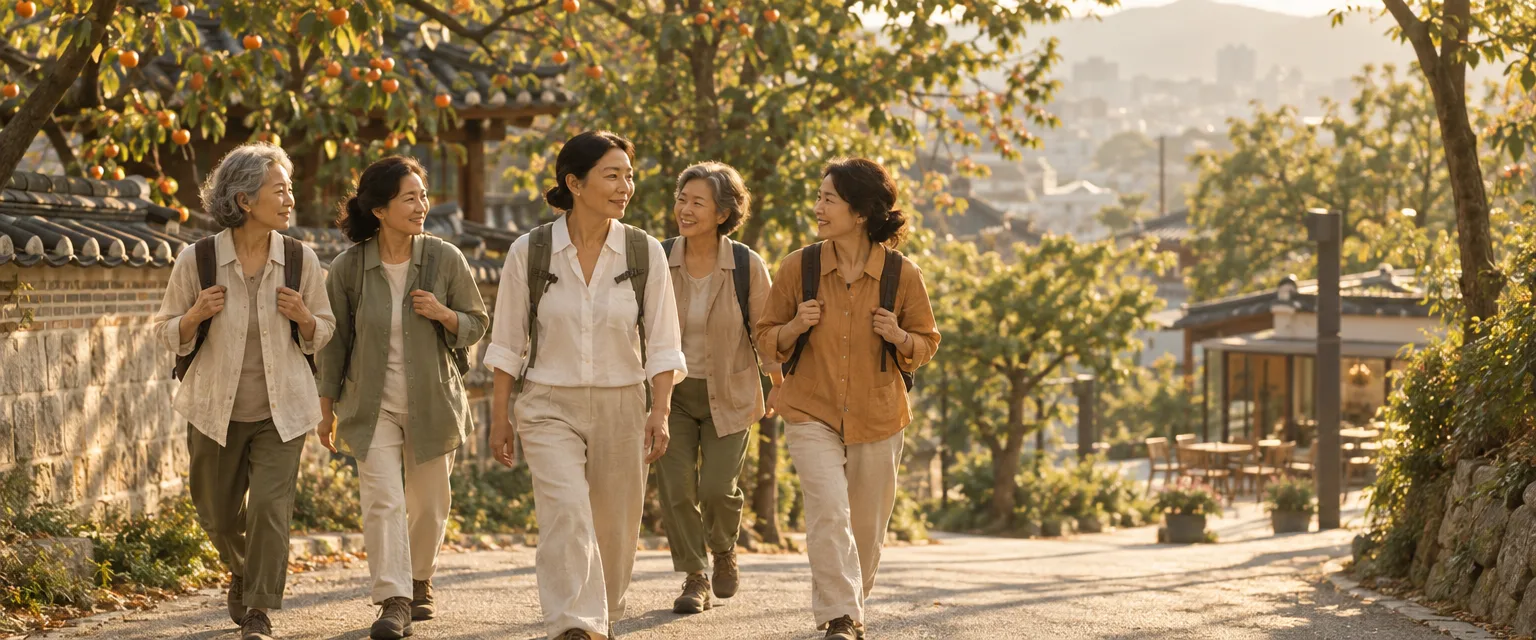
Consider a woman in her late 50s living in a residential neighborhood of Seoul. She runs a small consulting practice from home, coordinates her mother's medical appointments, and maintains an active social life. By most measures, her week is full.
And yet it is structured differently from what many Western women would recognize.
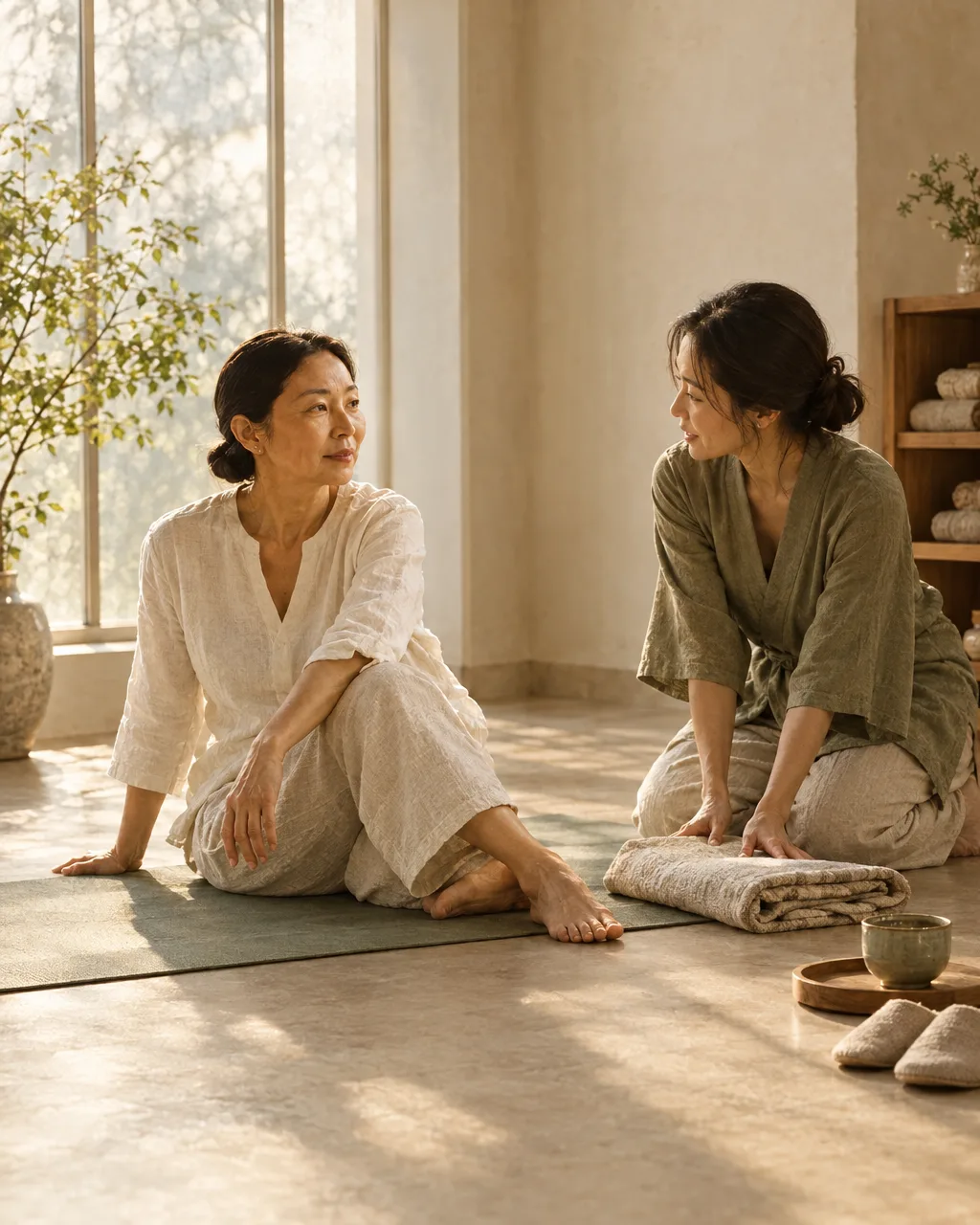
Cultural observation: Monday and Tuesday are her high-output days. She works with focused intensity, takes calls, handles correspondence. She moves with purpose. Wednesday morning she attends a movement class at a neighborhood wellness center, something between yoga and light stretching, with six women she has known for four years. They go for tea afterward. The conversation is unhurried. By Wednesday afternoon she is back at her desk, but the quality of her attention has shifted. Something has been returned to her.
Thursday she takes a shorter work day by design. In the early evening she visits the jjimjilbang, the traditional Korean bathhouse, a ten-minute walk from her apartment. She has been doing this most Thursdays for a decade. She does not think of it as self-care in the Western sense. She thinks of it as maintenance, the way you maintain anything you want to keep working well.
Saturday morning she wakes without an alarm. She does not look at her phone until after breakfast. She walks with a friend through a hillside park near their neighborhood, a walk that takes about an hour and covers terrain that requires some attention. They talk the entire time. In the afternoon she cooks something unhurried, perhaps a fermented soybean soup that takes most of the afternoon to develop properly. She is not rushing toward anything.
By Sunday evening, she spends twenty minutes planning the week ahead. Not a task list. A values check: what matters most this week, what she wants to protect, what she is willing to release. She is asleep before 10pm.
This is not a luxury schedule. She is not wealthy in a way that exempts her from demands. She has simply made a series of deliberate choices about how her week is structured. Those choices reflect something Korean culture has named and practiced for a long time.
The Philosophy Behind the Rhythm: Understanding Eum-Yang
The following is a cultural and philosophical overview. Eum-Yang is not a clinical construct, and its health applications in traditional Korean medicine are not equivalent to evidence-based Western medicine.
The concept underlying this woman's week is called Eum-Yang (음양). It is the Korean articulation of what most Westerners recognize as yin-yang: the principle that health and function depend on the dynamic balance between opposing but complementary forces.
Yang represents activity, effort, outward energy, engagement with the world. Eum represents rest, inwardness, receptivity, restoration. Neither is superior. Neither is optional. Korean traditional thought holds that sustained imbalance in either direction, too much Yang without recovery, or too much Eum without engagement, is a precursor to dysfunction.
What is elegant about this framework is how practical it becomes once you stop treating it as philosophy and start treating it as a design principle. The question it asks of any week is simple: does this week have enough Eum?
For most Western women in midlife, the honest answer is no.
Korean Perspective: Korean culture does not treat rest as the reward for completed work. It treats rest as a necessary component of the week, as legitimate as any professional commitment. The jjimjilbang visit, the unhurried Saturday morning, the Wednesday tea after movement class, these are not indulgences. They are infrastructure. And infrastructure, by definition, is not optional.
What the Research Says
The science does not use the language of Eum and Yang. But it arrives at a structurally similar conclusion.
Clinical evidence: Sustained elevation of cortisol, the body's primary stress hormone, is associated with accelerated cellular aging measured by telomere shortening, impaired immune function, disrupted sleep architecture, and increased risk of cardiovascular disease and cognitive decline. A 2012 study published in Psychoneuroendocrinology found that chronic stress was associated with significantly shorter telomere length in women, an effect comparable in magnitude to smoking. The implication is not that stress is avoidable. It is that recovery from stress must be as deliberately structured as the stress-producing activities themselves.
Researchers including Jim Loehr and Tony Schwartz have studied this oscillation principle in professional performance contexts and found consistently that people who build deliberate recovery into their schedules sustain higher performance over longer periods than those who operate on a continuous-output model. The biological mechanisms involve cortisol regulation, autonomic nervous system balance between sympathetic and parasympathetic activation, and sleep-dependent cellular repair.
Clinical Insight: The effects extend beyond energy and mood. Chronic stress and insufficient recovery influence sleep quality, hormonal balance, and systemic inflammation, the same biological processes that affect skin, posture, energy, and the visible markers of aging. How a week is structured is not separate from how a woman looks and feels as she ages. For many researchers, it is upstream of it.
Korean women are not relying on discipline to maintain this balance. They are relying on systems: the standing Wednesday class, the Thursday bathhouse visit, the Saturday walk with a long-standing friend. The system does the work that willpower cannot sustain.
What an Imbalanced Week Looks Like
Before designing a more balanced week, it is worth being honest about what imbalance actually looks like. The following patterns are cultural observation rather than clinical diagnosis, but they are recognizable.
Too much Yang, not enough Eum: - Five or more days per week with back-to-back commitments from morning through evening - Movement practice that is exclusively high-intensity, with no low-effort activity for recovery - A social calendar that is dense but not restorative, obligations rather than genuine connection - No protected morning time before external demands begin - Digital access from the first moment of waking to the last moment before sleep - Vacations structured around activity rather than restoration
The consequences over time: Depleted energy that requires increasing caffeine to maintain. Sleep that is technically adequate but not restorative. A growing sense that you are performing your life rather than living it. Reduced capacity for genuine presence in the relationships and experiences that matter most.
This is not a character flaw. It is a structural problem. And structural problems have structural solutions.
A Balanced Week Template: The Korean Approach in Practice
The following template is illustrative, not prescriptive. Adjust every element to your actual life. The principle matters more than the specific days: every week needs deliberate alternation between Yang activities and Eum activities, and the Eum elements must be protected with the same seriousness as professional commitments.
Monday and Tuesday: Yang High-output professional or creative work. One strength or resistance training session. Social engagement that is genuinely energizing. Notifications managed to specific check-in windows rather than continuous access.
Wednesday: Yang with Eum Moderate work demands. One community-based movement session. One hour of protected reading or learning with no screens and no multitasking. Something that returns attention to yourself.
Thursday: Eum-leaning Lighter work schedule where possible. Low-intensity movement: walking, stretching, gentle yoga. One genuine social connection, a real conversation with someone you care about, not a logistical exchange. A jjimjilbang visit if accessible, or a home bath ritual as a domestic equivalent. This is your maintenance appointment. Treat it accordingly.
Friday: Yang with transition Close the work week with intention. One strength session. An evening transition ritual: a deliberate marker between the work week and the weekend. A specific meal, a walk, a change of environment. Something that signals the shift.
Saturday: Eum-dominant No scheduled obligations before 10am. One extended low-intensity physical activity: a long walk, a hike, a gentle movement class. One creative or restorative practice: cooking something unhurried, reading for pleasure, a cultural visit, a long conversation with someone whose company restores you. Minimal screen time until evening.
Sunday: Eum with forward intention Morning restoration. Light movement. Twenty minutes in the afternoon to review the week ahead, not a task list, but a values check. What matters most this week? What do I want to protect? What can I release? Sleep preparation begins early. The nervous system needs time to downshift.
Early Warning Signs and Simple Corrections
The Eum-Yang framework is most valuable not just as a design tool but as a diagnostic one. The habit of noticing when your week has drifted, and making small corrections before the imbalance compounds, is the practice itself.
Signs your week has become too Yang: - Waking before your alarm and being unable to return to sleep - Feeling mentally active but physically depleted - Small problems feeling disproportionately significant - Relying on caffeine, sugar, or continuous task-switching to maintain output - Being unable to recall the last time you felt genuinely restored
Corrections: Move your bath or jjimjilbang ritual earlier in the week rather than saving it for the weekend. Add a 20-minute walk at midday. Protect one morning per week from any scheduled commitment. Release one social obligation that is maintenance rather than genuine connection.
Signs your week has become too Eum: - Persistent low motivation that does not improve with more rest - Social withdrawal that feels like relief rather than genuine restoration - Absence of anything you are working toward or contributing to - A sense that time is passing without meaning
Corrections: Reintroduce one structured contribution commitment. Add one Yang element to each day: a movement session, a creative output, a meaningful task. Reconnect with the purpose framework in The Korean Longevity Mindset.
The Balanced Week Planner
Five minutes on Sunday evening. The goal is not to fill every slot. It is to ensure that both Yang and Eum are present and protected.
This week's Yang priorities (maximum three): 1. 2. 3.
This week's Eum commitments (non-negotiable): - Protected morning: [day] - Low-intensity movement: [day and type] - Restorative connection: [day and person] - Sleep preparation begins at: [time, on which days]
What I am releasing this week:
What I am protecting this week:
Use this planner consistently over several weeks. The pattern it reveals, what you always over-schedule, what you always release, is more informative than any single week's data.
Frequently Asked Questions
Is Eum-Yang the same as yin-yang? The concepts share roots in classical Chinese philosophy that influenced Korean traditional thought. Eum-Yang is the Korean articulation. In Korean traditional medicine (hanbang), it carries specific diagnostic and treatment applications. Here, I am using it as a practical design principle for weekly life, not as a medical claim.
Can high-intensity exercise be Eum? No. High-intensity exercise is Yang by definition: effortful, activating, and demanding of recovery. The common error is filling a movement practice exclusively with Yang-type activity and calling the absence of a workout rest. Eum movement is genuinely low-intensity: walking at a conversational pace, gentle stretching, restorative yoga. Both matter. The balance between them is the practice.
What if my professional life requires five high-output days? Then the Eum work happens in the quality of each evening and in the intentional protection of Saturday morning. A week does not need to be balanced within every day. It can be balanced across the week if the weekend mornings are genuinely protected. That protection is the starting point.
How does this relate to sleep? Sleep is the most fundamental Eum state there is. Sleep-dependent cellular repair, memory consolidation, and immune function all depend on the nervous system downshifting from sympathetic to parasympathetic dominance. A week with insufficient Eum during waking hours tends to produce lower-quality sleep, because the nervous system has not practiced the downshift often enough to execute it reliably at night.
Is there a Korean term for the feeling of being too Yang? Cultural observation: The term gwaro (과로) refers to overwork or excessive labor and carries clearly negative connotations in Korean culture. While Korea has its own well-documented work-intensity pressures, the traditional value of balance encoded in Eum-Yang represents an aspirational counterforce, one that many Korean wellness practitioners actively promote as a corrective.
What You Can Do This Week
Choose one from the list below. Do it before the week ends.
- Identify the most Yang-heavy day in your current week. Add one Eum element to that day that takes 30 minutes or less: a walk, a bath, a meal eaten without screens.
- Schedule a standing weekly commitment that is purely restorative: a movement class, a walking date, a bathhouse visit. Put it in your calendar as a non-negotiable before you close this article.
- Spend 20 minutes on Sunday evening using the Balanced Week Planner above. Do it before planning any work commitments.
- Remove one recurring obligation from this week's calendar that is maintenance rather than meaning. Use that time for something that returns something to you.
The Korean approach is not about doing less. It is about designing a week in which effort and recovery alternate deliberately, so that when you show up, you have something to give.
Elle's Perspective
I came to Eum-Yang not through study but through observation. Watching the women I most admired in Korean wellness culture, I noticed that their weeks had a quality mine lacked. Not ease, exactly. Not leisure. Something more like rhythm: a deliberate alternation between engagement and restoration that meant they arrived at Monday morning with something to give, rather than already running on reserve.
The Western model I grew up with treated rest as the absence of productivity, something earned after the work was finished. What Korean traditional thought offers is a different premise entirely: rest is not what happens when you stop. It is a practice in its own right, as essential to function as the effort it supports.
The luxury is not the serum on your skin or the membership at the clinic. The luxury is the week designed to support the biology underneath all of it.
Build the Eum first. Let everything else compound from there.
Disclosure: Seoul Style Edit occasionally includes affiliate links to products we have researched and believe align with our focus on evidence-based wellness and longevity. These are marked clearly and never influence our editorial content.
Next on Seoul Style Edit: The Korean Anti-Frailty Protocol: How Women Over 50 Stay Strong, Mobile, and Independent.
Filed under 의도Purposeful Living