Korean Minimalist Interiors: A Calmer Home After 40
A calmer home does not require empty rooms or an expensive renovation. We look at Korean design, what the clutter and cortisol research really found, and small changes worth trying this week.
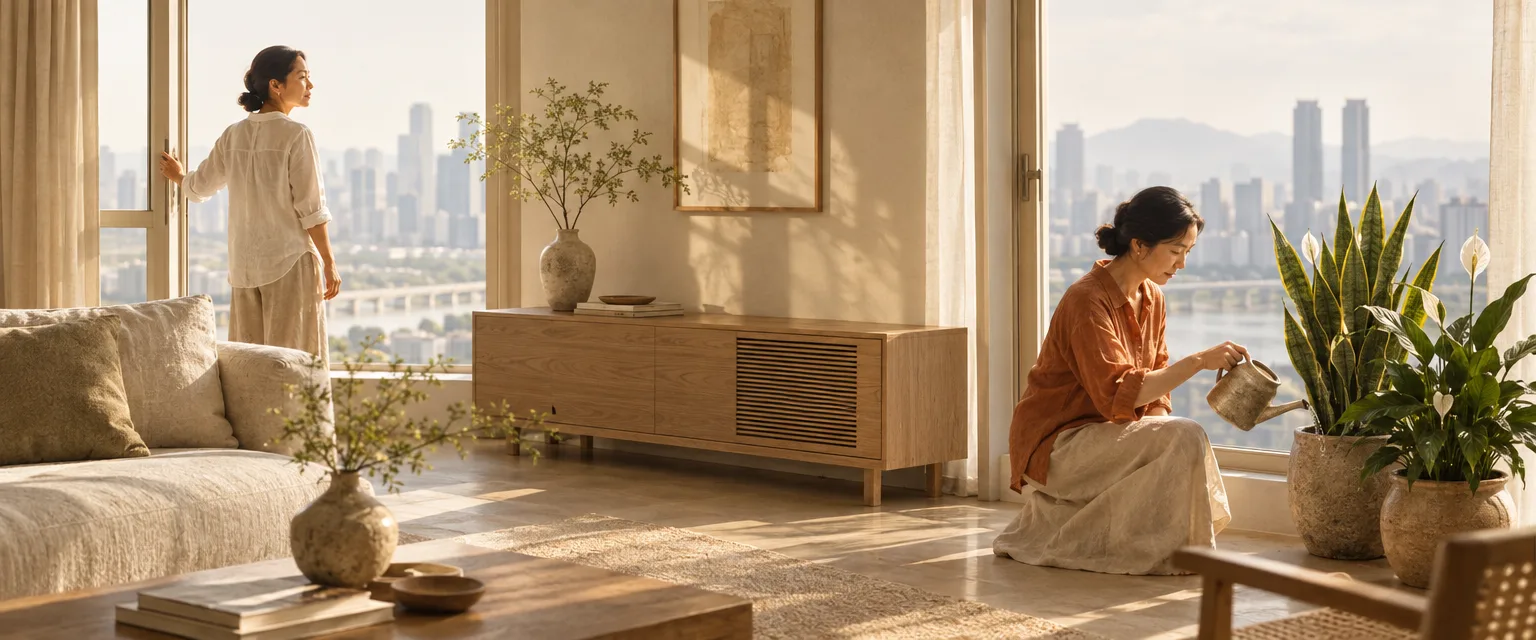
A beautiful home offers more than something lovely to look at. Research has linked women's experience of their homes with mood and daily patterns of cortisol, which suggests our surroundings deserve attention as part of everyday wellbeing (Saxbe and Repetti, 2010). That gives us a reason to look past the appearance of Korean minimalist interiors and ask what their thoughtful use of space might offer our own homes. You do not need a high-tech Seoul apartment or an expensive renovation. Reducing unwanted clutter, making everyday tasks easier, and creating a comfortable place to rest are practical starting points.
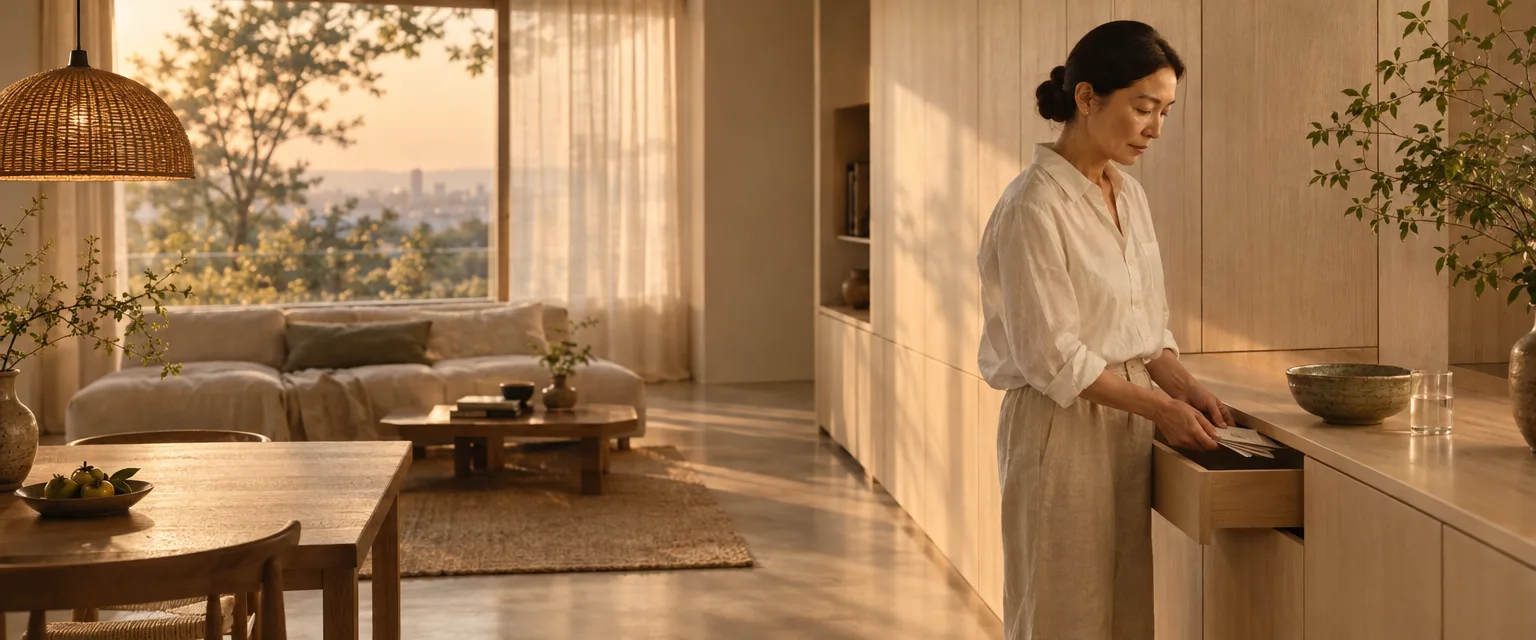
The kitchen counter has become a holding area for mail, supplements, and things someone needs to return. A chair in the bedroom carries tomorrow's outfit and yesterday's laundry. Nothing is particularly wrong with the house, yet sitting down in it can feel like being reminded of everything still to do.
Here, "Korean minimalist interiors" means a Korean-inspired approach to natural materials, useful storage, and visual restraint. It is not a single style shared by every Korean household, and it leaves room for family life, the things you love, and somewhere comfortable to rest.
What we can borrow from Korean design
The oldest reference point is the hanok, the traditional Korean house. Seoul's own account of hanok architecture emphasizes its relationship with nature and its use of materials such as wood and soil (Seoul Metropolitan Government). These are architectural and cultural qualities rather than medical ones, but they explain a sensibility that still runs through Korean interiors today.
For a contemporary example, consider the Sharp First World residence in Songdo, Incheon. Designed by 123o studio, the 178-square-meter home pairs pale surfaces and natural oak veneer with integrated storage. Custom cabinetry hides belongings and service infrastructure behind continuous surfaces, which keeps the living spaces calm and uninterrupted (Leibal).
The idea worth borrowing is simple: storage is planned as part of the room, not solved after the furniture arrives. Most Western homes are furnished the other way around, which is how the dining table becomes a desk and the counter becomes a filing system.
You do not need custom millwork to apply it. A cabinet for paperwork beside the kitchen, a generous drawer for skincare, or an entry cupboard that can actually hold the family's shoes all follow the same principle.
What the cortisol study actually found
The study behind most claims about clutter and stress was published in 2010 by psychologists Darby Saxbe and Rena Repetti. They analyzed how 60 dual-income spouses described their homes during self-guided tours, then tracked mood and cortisol over the following three weekdays (Saxbe and Repetti, 2010).
Among the wives, descriptions that emphasized clutter and unfinished projects were associated with flatter daily cortisol slopes. Descriptions that emphasized restfulness and nature were associated with steeper slopes, and the two kinds of description also tracked with how depressed mood changed across the day.
Why does the slope matter? Cortisol is not a toxin to eliminate. It helps regulate blood pressure, blood sugar, metabolism, and the stress response, and it normally runs higher in the morning and falls through the day (MedlinePlus). A steeper slope reflects that healthy daily rhythm. A flatter one suggests the body is not winding down as it should.
One honest boundary: this study measured an association. It did not test whether decluttering changes hormone patterns, so no one can promise that clearing a room will lower your cortisol. What it does show is that how a woman experiences her home is connected to how her days feel, and that makes the home worth examining.
Why visual quiet is worth exploring
Neuroscience offers a partial explanation for why a busy room can feel tiring. Laboratory research shows that multiple objects in view compete for representation in the brain's visual system, which is part of why attention has to be selective (McMains and Kastner, 2011). That does not mean a full bookshelf causes chronic stress. It does suggest why clearing a surface can make a room feel easier to rest in.
Treat visual quiet as an experiment, not a rule. A useful distinction is between belongings you enjoy seeing and things you have not decided what to do with. A piece of pottery, a family photograph, and a stack of favorite books are intentional. A pile of unopened envelopes is asking for a different kind of attention.
Warmth belongs in a minimalist home
Korean research adds an interesting layer here. A 2026 review from Korea's National Institute of Forest Science examined 24 experimental studies of wood interiors and human responses. Psychological results were generally favorable, with people reporting less fatigue and anxiety and more comfort. Physiological results, including some reported drops in cortisol, were more mixed, and most studies were short, small, and conducted in laboratory settings (Lee and Eom, 2026).
So wood is not a prescription. It is a reason to choose materials you genuinely enjoy living with. An existing wood table, a comfortable upholstered chair, a woven shade, or a ceramic bowl brings warmth without filling every surface.
This is where the Western picture of minimalism often goes wrong. Keep color if you love it. Keep the patterned rug if it makes the room feel like yours. Restraint is a tool for making a space work, not a requirement to live in beige.
The Elle-Approved Edit: start where you rest
Choose one view you see every day: the view from your favorite chair, the kitchen table where you have coffee, or the bedside surface you look at before sleep. Take a photograph of it and ask what you would change for your own comfort.
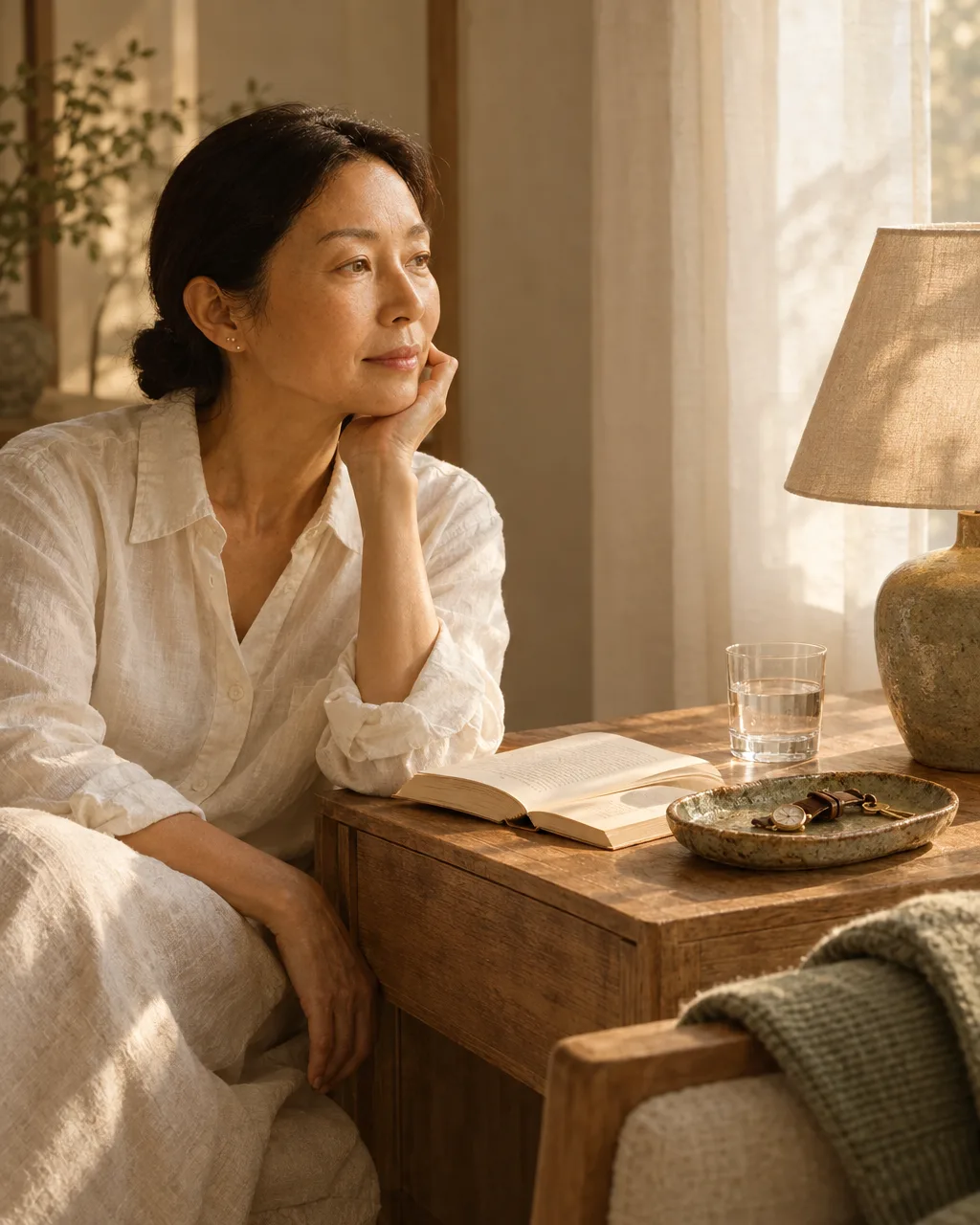
- Clear one useful surface. Make room for the activity that belongs there. On a bedside table, that might mean a lamp, your current book, and water, with paperwork moved elsewhere.
- Give recurring items a nearby home. Store chargers where you charge devices and paperwork where you open it. The best system takes one easy action to use.
- Keep meaningful objects visible. Choose what you genuinely want to see, and rotate the rest with the seasons.
- Make the room easy to use. Can you reach the lamp, set down a cup, and move around the furniture? A beautiful arrangement still has to work on an ordinary evening.
- Share the system. If others live with you, agree together where the mail goes and who clears the table. A basket everyone uses beats a labeled system only you maintain.
Hold off on shopping. Live with the first changes for a week before buying organizers. You may find you already own the right cabinet, or that the real problem is a task nobody has agreed to take on.
Elle's Perspective
What draws me to Korean interiors is not the emptiness. It is the sense that everything has been decided. The calm comes from a home that asks nothing of you when you walk in. I find that far more useful than any rule about how many objects a room should hold. Give yourself 20 minutes this week with the one spot where you most want to feel at ease. Remove what belongs elsewhere, make one practical improvement, and keep what you love. Then notice whether you actually want to sit there. A change worth keeping is one that fits your life, not one that photographs well.
Frequently Asked Questions
Does decluttering lower cortisol? Not proven. The best-known study found that women who described their homes as cluttered had flatter daily cortisol patterns, but it measured an association and did not test decluttering itself. Treat a calmer home as a reasonable experiment, not a medical treatment.
Do I have to get rid of my things to have a Korean minimalist home? No. The Korean approach is about planned storage and visual restraint, not owning less for its own sake. Keep what you love on display and give everything else a home behind a door.
What is the easiest first step? Pick one surface you see daily, such as your bedside table or kitchen counter, and spend 20 minutes clearing what does not belong there. Live with the change for a week before buying anything.
Filed under 집Home as Medicine