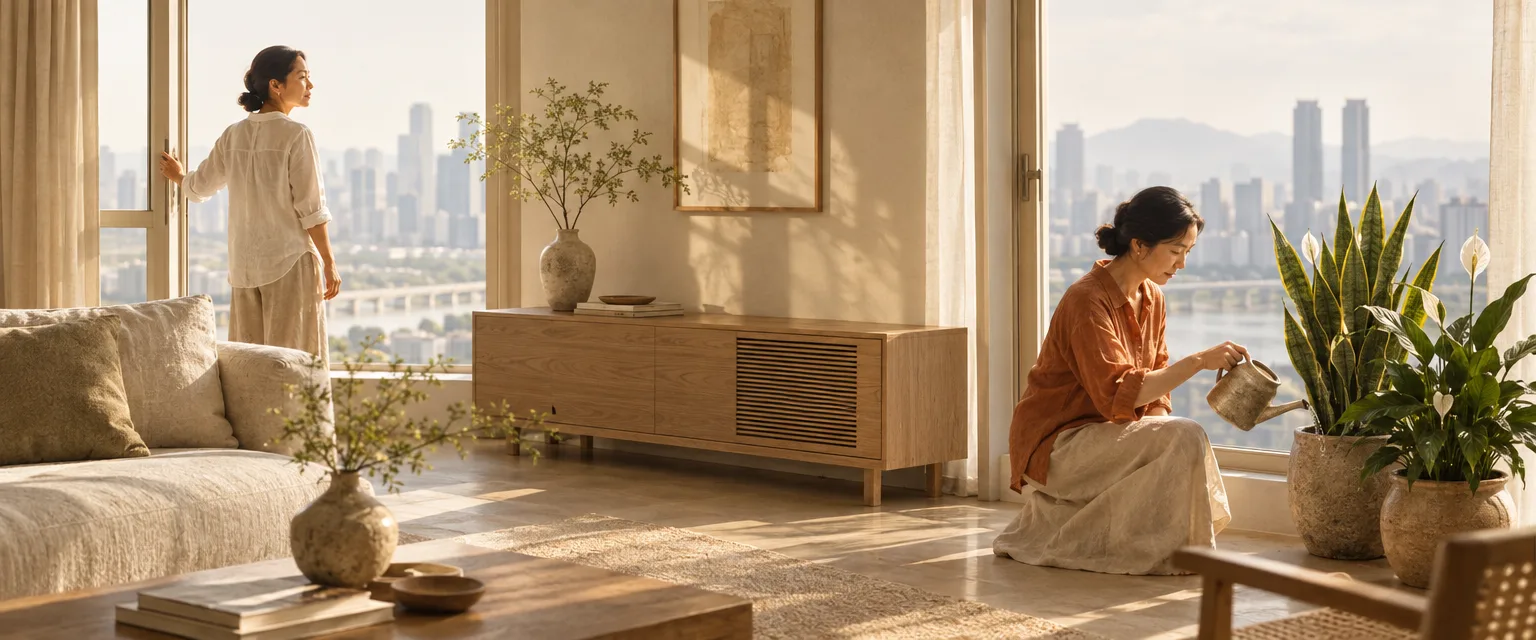
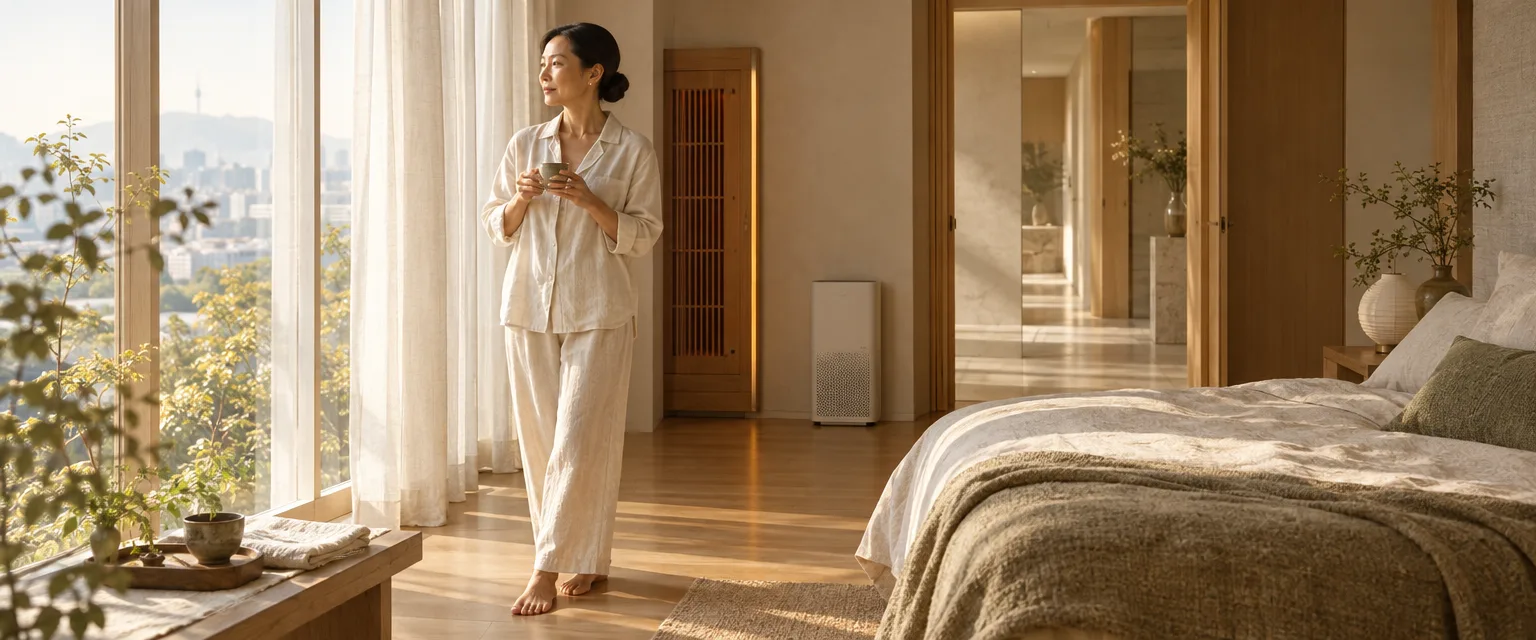
The Korean Sauna Ritual: Why Women in South Korea Treat Heat, Bathing and Rest as a Practice for Healthy Aging
In South Korea, sauna is not simply a room where the body becomes hot. It is a restorative sequence of bathing, warmth, cooling, nourishment, stillness and human connection. Here is what this distinctly Korean ritual can teach women over 40 about creating a calmer, more sustainable approach to wellness at home.
Affiliate disclosure: Seoul Style Edit does not currently have affiliate or partnership relationships with the sauna manufacturers named in this article. Links go directly to manufacturer or authorized-dealer product pages for your reference.
In Seoul, wellness does not always announce itself as wellness.
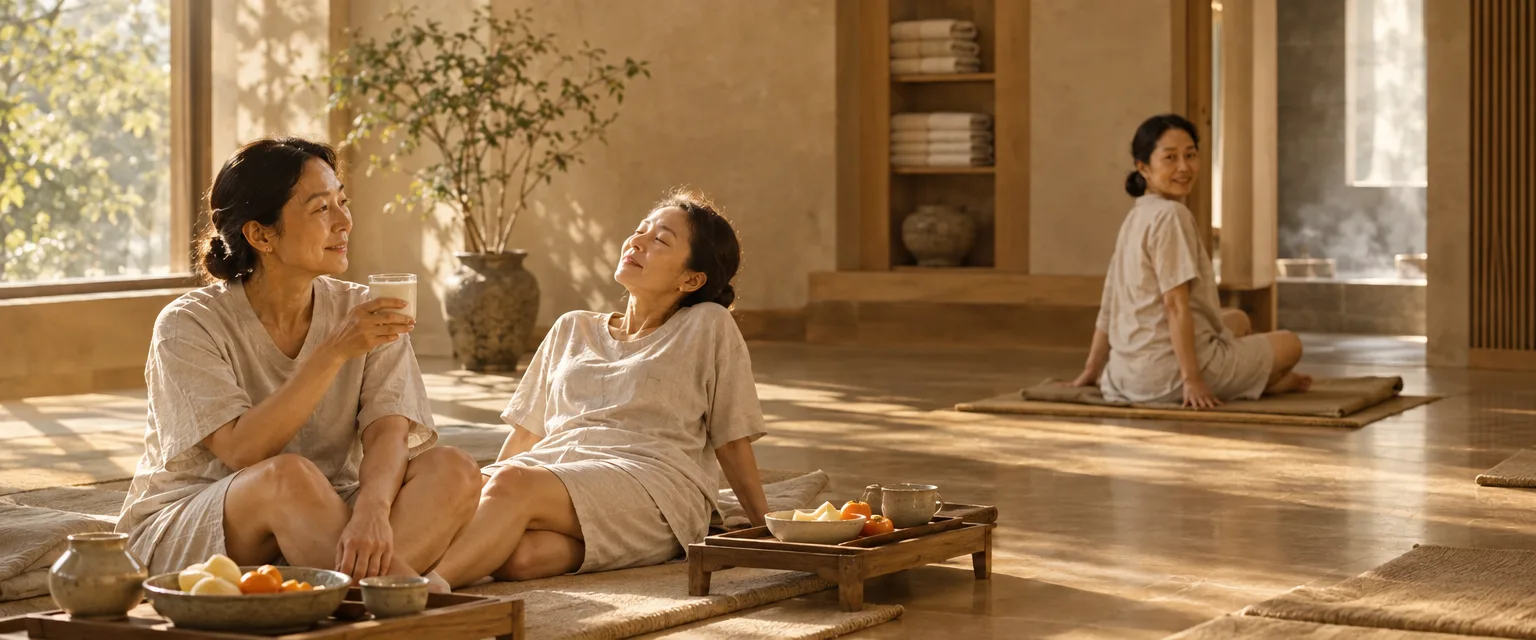
It may look like a mother and daughter sitting quietly beside one another in a warm salt room. A group of longtime friends sharing fruit and conversation on a heated floor. A woman moving between a hot bath and a cool rinse before wrapping herself in a fresh robe and closing her eyes.
There is no biometric dashboard. No demand to optimize every minute. No pressure to transform relaxation into another form of work.
There is simply warmth, water, time and permission to stop.
This is the deeper appeal of South Korea's jjimjilbang tradition. Often translated into English as "Korean sauna," the jjimjilbang is not one particular kind of sauna. It is a larger bathing and leisure environment that may combine gender-separated bathing areas, hot and cold pools, steam rooms, dry heated rooms, communal lounges, food, massage, sleep and conversation.
The sauna is part of the experience, but it is not the entire experience.
What makes the Korean approach so relevant to women in midlife is not the promise that one intensely hot session will reverse aging. It is the way the ritual makes restoration repeatable. Heat is placed inside a larger system of bathing, sensory quiet, social connection and deliberate recovery.
That may be the most important Korean lesson of all: healthy aging is supported not by occasional extremes, but by rituals the body and mind are willing to return to.
Jjimjilbang Is More Than a Sauna
The word jjimjil refers broadly to heating or applying warmth to the body, while bang means room. A jjimjilbang is therefore, quite literally, a collection of heated rooms, though its cultural meaning is much richer.
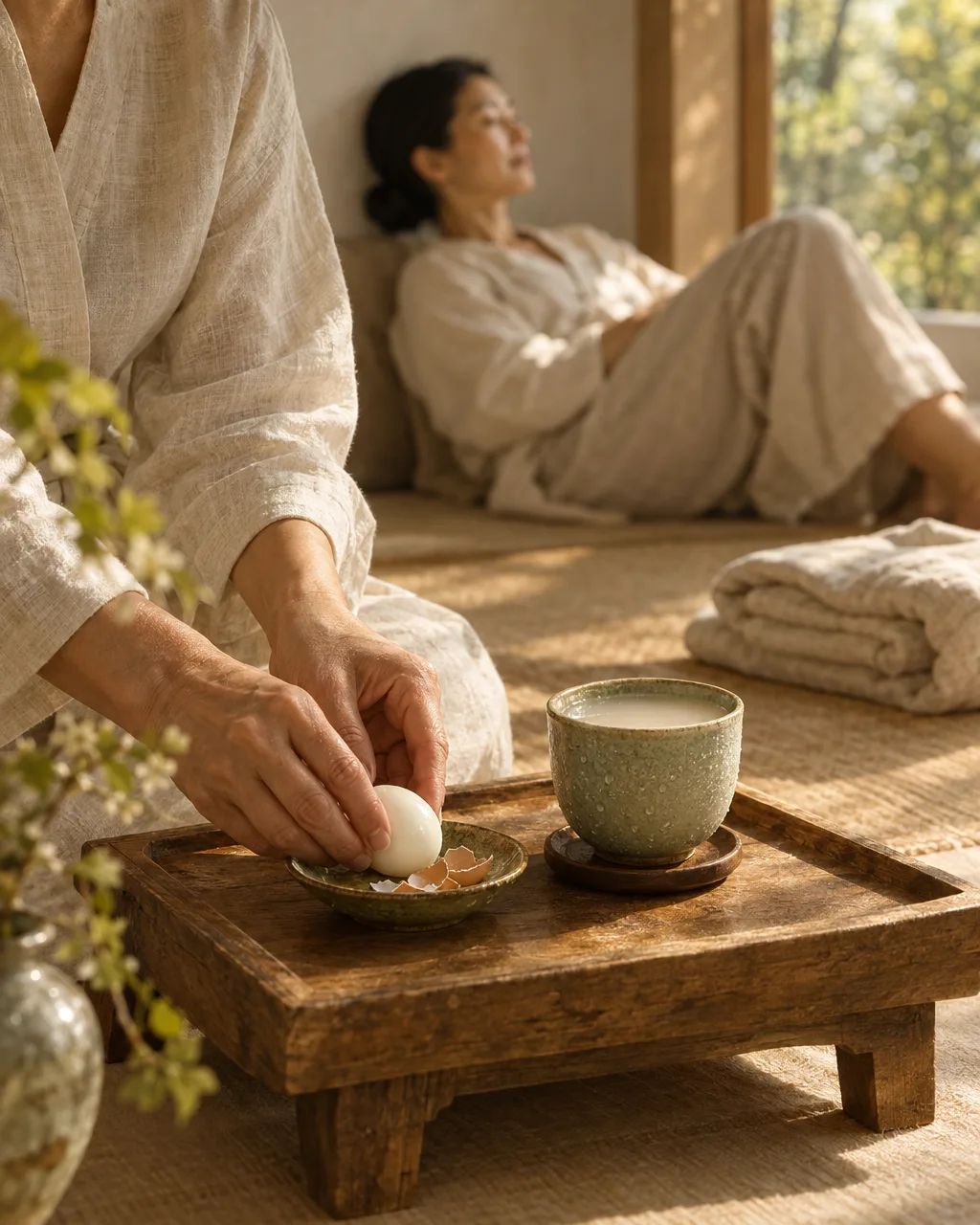
Cultural observation: A typical Korean jjimjilbang may contain rooms finished with salt, clay, stone, charcoal or wood, each maintained at a different temperature. Traditional snacks, including roasted eggs and chilled sikhye, a sweet rice drink, are often part of the ritual. Visitors may read, nap, watch television, receive a body scrub or simply rest on a heated floor between rounds of warmth.
The bathing areas are generally separated by gender. Visitors shower before entering the pools and normally bathe without clothing. After bathing, they change into the shorts and T-shirt provided by the facility and enter the communal jjimjilbang areas, where families and friends can relax together.
This distinction matters because Westerners often imagine a sauna session as a single activity: enter a hot wooden room, remain there for a designated number of minutes and leave.
The Korean experience is more spacious.
One moves through it rather than simply enduring it.
There may be warmth, followed by cooling. Conversation, followed by silence. Cleansing, followed by nourishment. The body is given time to settle before returning to ordinary life.
In this sense, the jjimjilbang is not merely a heat-therapy facility. It is a social and sensory environment designed around the idea that human beings need somewhere to recover.
A Practice With Deep Cultural Roots and a Modern Form
Korean bathing history is older and more complicated than the modern jjimjilbang.
Cultural observation: Historical Korean bathing was associated with cleanliness, beauty, ritual preparation and, at times, the treatment of illness. Korean records describe bathing practices reaching back to ancient periods, while sweat bathing known as hanjeung appears in written records from the Joseon era. In 1422, King Sejong reportedly directed officials to investigate whether sweat bathing was effective in treating illness.
Modern public bathhouses developed more fully during the late 19th and early 20th centuries as Korean cities changed and public hygiene became a larger social concern. Seoul records show that a bathhouse near Cheonggyecheon advertised the installation of a hanjeungmak, or heated sweat room, in 1901. Public bathhouses later became part of everyday urban life, eventually developing into the larger, multifunctional jjimjilbang facilities recognized today.
The modern jjimjilbang is therefore neither an unchanged ancient institution nor simply a Korean version of a Finnish sauna. It is a distinctly contemporary Korean environment created from several influences: indigenous heat traditions, public bathing, urban leisure, family recreation and Korea's broader culture of the bang, or specialized room.
One cultural study described the jjimjilbang as a kind of "hidden public space," a place where private behavior such as bathing, sleeping and resting occurs within a shared social environment.
That mixture of the private and communal is central to its appeal.
A person can be alone without being isolated. She can arrive with friends but remain quiet. She can rest among other people without needing to perform socially.
For women who spend much of their lives caring, organizing, anticipating and responding, that form of unstructured companionship can feel especially restorative.
Why the Sauna Matters to Korean Women in Midlife
It would be inaccurate to suggest that every South Korean woman uses a sauna or that jjimjilbang attendance alone explains Korean longevity. South Korea is a highly diverse, modern society, and its bathing culture continues to change.
Smaller neighborhood bathhouses have declined as private bathrooms have improved and lifestyles have shifted. Seoul Archives reported that, of the 3,930 bathhouse businesses licensed in the city since the early 20th century, 675 remained in operation at the end of 2024. At the same time, larger spas and modern jjimjilbangs have evolved into more comprehensive relaxation and cultural spaces.
Yet research suggests that sauna culture continues to hold particular social meaning for some Korean women in midlife.
Emerging evidence: A study published online in October 2025 interviewed 15 Korean women between the ages of 40 and 65 about their sauna experiences. Participants described the sauna as a place where they developed membership, emotional connection and a meaningful sense of community. They shared food, participated in one another's personal events and found that needs for enjoyment and social interaction were met within the group.
The study was small and cannot represent all Korean women. But it captures something that conventional Western wellness language often overlooks.
The benefit may not come only from the heat.
It may also come from having a place where a woman is known.
In Korean sauna culture, regular visitors may develop familiar routines and relationships. The sauna becomes a kind of third space, not home and not work, but somewhere in between. It offers companionship without the formality of hosting, dressing for dinner or organizing an elaborate social event.
This matters for healthy aging because human connection is not ornamental. Belonging, social support and participation are important dimensions of well-being in midlife and later life. Korean research has also found relationships among age-friendly environments, social support, community and loneliness in adults aged 45 and older.
For some women, the sauna supports all of these at once: physical relaxation, routine, friendship and a temporary release from ordinary social roles.
The Mental Calm Is Not Only About Temperature
Heat may be the most obvious element of sauna bathing, but mental calm is created by the entire architecture of the ritual.
Inside a sauna, there is very little to accomplish.
The body is occupied with a simple sensory experience. Warmth becomes difficult to ignore. Breathing becomes more deliberate. Conversation often slows. Phones may be set aside. The attention that normally moves between appointments, messages and family responsibilities is brought back to the immediate moment.
This does not make sauna bathing a medical treatment for anxiety or depression. The evidence is not yet strong enough to make that claim.
Emerging evidence: What research does show is that people commonly use saunas for relaxation, stress reduction and social connection. In a global sauna survey, participants frequently reported relaxation, pain relief and socializing as reasons for sauna use. Many also reported perceived improvements in sleep, although the survey design cannot prove that sauna caused those improvements.
A 2026 qualitative study similarly found that regular sauna users described connection to themselves, emotional safety, community and a sense of equality within the sauna environment. Because that study was small and qualitative, it should be read as an exploration of people's experiences rather than definitive clinical evidence.
Still, the pattern is meaningful.
A sauna creates a boundary around rest. Once the door closes, there are fewer places for the mind to go.
The Korean ritual adds another layer: after leaving the heat, one does not necessarily rush away. There is a cooling period, a drink, a meal, conversation or time on the heated floor.
That transition may be just as valuable as the heat itself.
The nervous system is not asked to move instantly from exertion back into productivity. It is allowed to descend gradually.
What the Science Actually Says About Sauna and Healthy Aging
Sauna research is promising, but it requires careful interpretation.
The strongest long-term studies have generally examined traditional Finnish-style dry sauna bathing, not Korean jjimjilbangs, infrared cabins or steam showers. Many of the widely repeated longevity findings also come from observational research, particularly research involving Finnish men.
That means the studies can identify an association between frequent sauna use and certain health outcomes, but they cannot prove that sauna use was the direct cause.
People who use saunas regularly may differ in other important ways. They may exercise more, have stronger social networks, possess greater financial resources or follow other health-supporting behaviors.
Nevertheless, several physiological effects of heat exposure are biologically plausible and have been observed in clinical settings.
1. The cardiovascular system responds to heat. When the body becomes warm, blood vessels near the skin dilate to release heat. Heart rate may increase, circulation changes and sweating begins.
Clinical evidence: Reviews of sauna research have proposed that repeated heat exposure may support aspects of vascular function, arterial flexibility, autonomic regulation and blood-pressure control. Frequent Finnish sauna bathing has also been associated with lower risks of cardiovascular and all-cause mortality in observational studies.
However, a more recent systematic review and meta-analysis of randomized trials examining several forms of passive heating found no significant pooled effects for many cardiometabolic and vascular outcomes. The authors emphasized the need for better-controlled research.
The honest conclusion is not that sauna has no cardiovascular value. It is that the evidence is encouraging but not complete.
Sauna should complement, not replace, movement, strength training, sleep, medical care and a nourishing diet.
2. Sauna use may support relaxation and perceived sleep quality. Many sauna users report feeling calmer or sleeping more deeply after a session. Heat followed by gradual cooling may create a subjective sense of muscular release and readiness for sleep.
These effects are plausible, but individual experiences vary, and high-quality trials remain limited. The most accurate language is that sauna may support relaxation and sleep routines, not that it cures insomnia or regulates every user's nervous system.
3. Heat may temporarily ease muscular stiffness. Warmth can create a temporary feeling of greater ease in tight muscles and joints. For women who strength train, walk extensively, travel frequently or spend long hours sitting, the sauna may become a useful transition from activity into recovery.
It is not a substitute for rehabilitation or medical treatment. But it can be a pleasant part of a broader mobility and recovery practice.
4. There are intriguing, but unproven, connections to brain aging. Some Finnish observational studies have associated regular sauna bathing with lower rates of dementia. One long-term study involving men and women found a lower dementia risk among some participants who reported approximately three sauna sessions per week, although the relationship was not consistent at every frequency or temperature.
This should not be interpreted as proof that buying a sauna will prevent Alzheimer's disease.
The findings are better understood as an important research question. Cardiovascular health, relaxation and social engagement may all influence brain health, and a regular sauna practice can potentially touch several of these areas. But no sauna type or schedule has been established as a dementia-prevention prescription.
5. The evidence is still developing. A systematic review of 40 clinical studies found potential benefits from regular dry-sauna bathing, but only 13 of the included studies were randomized trials, and many were small. The authors concluded that more research is needed to determine optimal sauna type, frequency, duration and suitability for different populations.
This distinction is essential for women approaching longevity thoughtfully.
Sauna is one potential health-supporting practice. It is not a guarantee of longer life.
What Sauna Does Not Do
In both Korean tradition and contemporary wellness marketing, perspiration is sometimes described as a way of releasing toxins.
Sweat can contain very small quantities of certain substances, including trace metals. Some research has measured these substances in perspiration, but that does not establish sauna bathing as a clinically meaningful treatment for toxin exposure.
The body's primary detoxification systems are the liver, kidneys, gastrointestinal tract and lungs. Sweat's principal purpose is temperature regulation.
A sauna should therefore not be marketed as a replacement for medical treatment, nor as a system that "flushes" significant toxins from the body.
It also does not produce meaningful fat loss simply because body weight is temporarily lower after sweating. Most immediate weight change after a sauna is water loss, which returns after rehydration.
The more credible benefits are quieter: creating a structured pause, encouraging physical and mental relaxation, supporting a consistent bedtime or recovery ritual, providing pleasurable heat exposure, helping some people feel temporarily less stiff, and, in the Korean model, strengthening social connection.
Those benefits may sound less dramatic than "detoxification," but they are more likely to support a sustainable practice.
The Korean Sauna Sequence to Recreate at Home
A home sauna cannot reproduce the scale or communal atmosphere of a Seoul jjimjilbang. It can, however, preserve the rhythm of the experience.
The objective is not to tolerate the highest possible temperature. It is to create a sequence the body begins to recognize as a signal for rest.
Step 1: Arrive before entering. Do not move directly from an email, meeting or workout into extreme heat. Allow several minutes to change, drink water and let your breathing settle. Place the phone outside or switch it to a noninteractive audio program. This moment marks the psychological entrance into the ritual.
Step 2: Cleanse. A warm shower before sauna use removes skincare products, perspiration and surface oils. It also creates a transition between the ordinary day and the sauna session. For a Korean-inspired ritual, cleansing is not a rushed preparation. It is the first part of the practice.
Step 3: Begin with moderate heat. People vary considerably in their heat tolerance. New users should begin conservatively rather than attempting to duplicate protocols used in research or social media. A brief initial session may be sufficient. Leave immediately if you feel dizzy, nauseated, weak, unusually short of breath, confused or uncomfortable. The appropriate temperature and duration also depend on whether the unit is traditional, infrared or steam.
Step 4: Cool gradually. Cooling does not need to mean an ice bath. A room-temperature shower, fresh air or quiet seated rest may be more appropriate, particularly for beginners and people with blood-pressure concerns. The American Heart Association advises people with high blood pressure not to move rapidly between very hot and very cold environments without medical guidance. The Korean lesson is contrast, not punishment.
Step 5: Rehydrate. Drink water before and after sauna use. Longer or more intense sessions produce greater fluid and electrolyte loss. Dizziness, headache, nausea, unusual weakness and muscle cramping can be signs that the heat exposure was excessive or hydration was inadequate.
Step 6: Preserve the after-sauna period. This is the element most often lost in American sauna routines. Do not treat the sauna as another task to complete before immediately returning to work. Wrap yourself in a robe. Drink tea or cool water. Sit on the floor or a comfortable chair. Eat a light meal. Read. Speak with someone you love. Let your body return to its usual temperature without urgency.
In the jjimjilbang, rest is not dead time between treatments.
Rest is the treatment.
Understanding the Three Home-Sauna Types
Before selecting a home unit, it helps to clarify the language.
Traditional dry sauna. A traditional dry sauna uses an electric or wood-burning heater to warm stones and the air inside the room. Temperatures are generally higher than in an infrared sauna. Humidity usually remains relatively low, but small amounts of water may be placed on the hot stones to create a brief wave of steam and humidity. It is still categorized as a traditional dry sauna, even when water is occasionally added. The Finnleo Hallmark 44 belongs in this category. It is not an infrared sauna and it is not a steam room.
Infrared sauna. An infrared sauna uses radiant emitters to warm the body more directly while operating at a lower air temperature than many traditional saunas. Some people find this gentler environment easier to tolerate for a longer period. Infrared cabins can also be comparatively easy to install because many two-person models use a 120-volt electrical connection. The long-term longevity evidence associated with Finnish sauna should not automatically be attributed to every infrared system. Infrared research exists, but the evidence base is smaller and more variable.
Steam room or steam shower. A steam room uses a generator to create warm, highly humid air. This is the closest of the three categories to a bathing-centered bathroom experience, but it is usually the most complicated to install. A premium steam system normally requires a properly waterproofed enclosure, plumbing, drainage, electrical work and accessible generator placement. A steam shower is therefore less like buying a piece of furniture and more like completing a specialized bathroom renovation.
The Seoul Style Edit Home-Sauna Selection
No representative research shows that affluent South Korean women collectively prefer a particular American sauna brand.
There is, however, a premium Korean home-sauna market built around materials such as cypress wood, salt, warm natural finishes and compact private cabins. Korean company DeSalt, for example, currently sells premium salt-and-cypress home saunas ranging from compact one-person cabins to larger family models. These Korean-market products help illustrate the desired aesthetic, but they may not have the voltage, US safety listing, warranty service or installation support required for an American home.
The following American-market recommendations should therefore be described as home saunas selected for American women inspired by South Korea's bathing and wellness culture. They should not be described as brands proven to be preferred by affluent Korean women.
Prices below were checked on August 31, 2026, where publicly available, and may change.
Best Traditional Dry Saunas
Luxury Design Choice: KLAFS S1
The KLAFS S1 is designed for a home where wellness equipment must coexist gracefully with sophisticated interiors.
The cabin extends from approximately 24 inches deep to about 63 inches, transforming from a shallow architectural element into a full sauna. Its SANARIUM system allows the owner to explore different combinations of heat and humidity rather than using only one dry, high-temperature setting.
Additional features include app control, Bluetooth audio, dimmable backrest lighting and UL-certified safety. The cabin requires a dedicated 240-volt electrical supply and mandatory professional white-glove installation.
Why it suits the Seoul Style Edit woman: it treats the sauna as part of the interior architecture rather than gym equipment. Its adjustable climates also reflect something appealing about the Korean jjimjilbang experience: wellness is not limited to one room temperature or one prescribed sensation.
Consider before buying: pricing is in the very-high-end luxury category and requires a current quote. The floor must be level, strong and nonporous. The unit cannot operate while retracted. Professional installation is mandatory.
Best for: a luxury city residence, primary suite or design-led wellness room where floor space is valuable.
Best Easy-Installation Dry Sauna: Finnleo Hallmark 44
For most American homeowners seeking a traditional dry sauna without undertaking a renovation, the Finnleo Hallmark 44 remains our preferred recommendation.
This is a genuine electric stone-heater sauna, not an infrared cabin.
Its Piccolo Mini heater warms sauna stones and the air. The owner may add a small amount of water to the stones to create a brief increase in humidity while preserving the traditional dry-sauna experience.
The Hallmark 44 is approximately 48 inches wide, 48 inches deep and 80 inches high, with seating for two. It is constructed from clear Canadian hemlock and includes a built-in floor, low-voltage color lighting, Bluetooth audio and SaunaLogic2 controls.
Most importantly, it is a 120-volt plug-in traditional sauna. Finnleo says the six-panel cabin can be assembled in less than an hour without plumbing, finishing work or a new 240-volt connection. Depending on the heater configuration, a dedicated circuit may still be required or advisable.
Why we chose it: traditional stone-heater saunas commonly require 240-volt service. The Hallmark 44 makes the experience accessible to homeowners who do not want an extensive electrical project.
Consider before buying: the panels are heavy, and two adults are required for assembly. The cabin weighs approximately 438 pounds. It is for indoor use. A compact 120-volt heater may warm more slowly than a larger 240-volt heater. Pricing is dealer-based; a 2025 promotional document placed its approximate retail value at $6,898, but buyers should obtain a current delivered quote.
Best for: an indoor home gym, wellness room, large bathroom or primary-suite dressing area.
Best Traditional Value: Almost Heaven Auburn
The Almost Heaven Auburn offers a larger and more powerful traditional sauna experience at a lower purchase price than many premium modular cabins.
It accommodates approximately two to three people and includes a 6-kW Harvia stone heater. The cabin is manufactured in the United States and offers two bench levels, a tempered-glass door and interior LED lighting.
Current specifications list the cabin at approximately 70 inches wide, 47 inches deep and 78 inches high. It requires a hardwired 240-volt, 30-amp connection. The base price was approximately $4,577, with professional installation offered starting at approximately $1,400, excluding electrical work and other site requirements.
Why we chose it: the Auburn offers more room and stronger heater output than many small plug-in units. It is a compelling value for a homeowner willing to hire an electrician.
Consider before buying: it is not a simple plug-in installation. Electrical work is additional. Delivery and room placement should be confirmed. Optional flooring, smart controls and material upgrades increase the final price.
Best for: a larger suburban home where authentic heat performance and value matter more than plug-in convenience.
Best Infrared Saunas
Luxury Technology Choice: Sunlighten mPulse Believe
The two-person Sunlighten mPulse Believe is designed for the buyer who wants infrared heat combined with guided technology.
It includes red and near-, mid- and far-infrared output, programmable wellness sessions, a touchscreen, Wi-Fi connectivity, chromotherapy and Bluetooth audio.
The basswood version was listed at approximately $8,699, reduced from $9,399, when checked on August 31, 2026.
Why we chose it: the principal advantage is personalization. A user who prefers guided programs may find it easier to build a repeatable routine when the experience is already structured.
Consider before buying: more technology also means more potential electronic service points. The product should not be selected because "full spectrum" is presumed to guarantee superior longevity. Buyers who want a screen-free sanctuary may prefer a simpler model. Confirm the exact electrical requirements, delivered price and in-home placement before purchase.
Best for: a technology-oriented buyer who enjoys customized wellness programs.
Best Premium Infrared Balance: Clearlight Sanctuary 2
The Clearlight Sanctuary 2 combines full-spectrum infrared heating with substantial cabin construction and extensive residential warranty coverage.
It measures approximately 52 inches wide, 48 inches deep and 77 inches high and weighs approximately 450 pounds. The cabin includes front full-spectrum heaters, far-infrared heaters around the body and beneath the floor, smartphone control, Bluetooth audio and chromotherapy.
The current US residential model uses a 120-volt, 20-amp NEMA 5-20 connection. Clearlight recommends leaving additional space around the unit, particularly if it is placed in an enclosure.
Clearlight presently advertises a limited lifetime residential warranty covering the cabin, heaters, controls, wiring and factory-installed audio components, with labor coverage subject to the warranty's time limits and terms.
Why we chose it: it offers an attractive balance of cabin quality, heater coverage, warranty support and comfortable two-person dimensions.
Consider before buying: national pricing is consultation-based rather than publicly transparent. The 450-pound cabin requires careful delivery planning. Confirm that the largest panel can fit through every doorway and hallway. Optional red-light or heater upgrades may change the electrical requirement.
Best for: the premium buyer who values warranty and construction more than elaborate wellness programming.
Best Value-Premium Infrared Sauna: Health Mate Enrich 2
The Health Mate Enrich 2 offers many of the features associated with more expensive infrared cabins while preserving a relatively simple electrical installation.
The two-person cabin combines mid- and far-infrared heaters with an integrated 96-diode near-infrared and red-light panel. It is made from Indonesian mahogany and includes Bluetooth audio, a towel rack and exterior lighting.
The Enrich 2 measures approximately 47 inches wide, 44 inches deep and 77 inches high. It uses a standard 120-volt, 15-amp plug and was priced at approximately $5,300 with curbside delivery. The manufacturer displays ETL and other international certification marks for the model.
Why we chose it: it is one of the clearest combinations of published pricing, compact dimensions, full-spectrum heating, integrated red light and straightforward electrical requirements.
Consider before buying: delivery is curbside rather than placement inside the home. The cabin still requires assembly and a clear delivery route. Read the full warranty rather than relying only on the "limited lifetime" headline. Treat low-EMF claims as one specification, not the sole measure of safety or quality.
Best for: a quality-conscious buyer who wants premium infrared features without moving into the highest price tier.
Best Steam Systems
Luxury Steam Choice: ThermaSol Total Wellness System
ThermaSol is the strongest luxury recommendation for a bathroom designed from the beginning as a private wellness environment.
Its systems can integrate a ProSeries steam generator, ThermaTouch2 or SignaTouch controls, a SteamVection steam head, a multisensory rainhead, digital shower controls, lighting, audio, aromatherapy, app and voice controls, seating and towel warming.
ThermaSol's packages range from relatively simple steam controls to complete systems combining steam, digital showering, light and sound. Generator size must be calculated according to the enclosure's dimensions and materials.
Why we chose it: a properly designed ThermaSol room can come closest to translating the multisensory nature of a premium Korean spa into an American primary bathroom. It does not merely provide heat. It creates a sequence involving water, steam, light, scent and rest.
Consider before buying: this is not an appliance installation. It is a construction project requiring a steam-rated waterproofing system, a sealed enclosure, plumbing, drainage, dedicated electrical service, safe steam-head placement, generator access and experienced tradespeople. Depending on the controls and rainhead selected, the hardware alone can enter five figures before the generator, enclosure, tile and labor are included.
Best for: a major luxury bathroom renovation or dedicated home wellness suite.
Best Mainstream Custom Steam Value: Kohler Invigoration
The Kohler Invigoration series is our preferred mainstream alternative for a homeowner who wants a custom steam shower from a familiar American plumbing brand.
Kohler offers generators in multiple sizes. As one example, the 9-kW K-5529 generator is rated for a maximum adjusted shower volume of 240 cubic feet. It includes fast-response technology, automated cleaning, temperature management and an automatic shutoff. A compatible control kit or digital adapter must be purchased separately.
Why we chose it: Kohler offers a comparatively straightforward path for a homeowner already working with a bathroom designer, plumber and Kohler showroom.
Consider before buying: the generator is only one part of the system. Controls and the steam head may be separate. The correct generator must be calculated for the finished enclosure. Porous stone surfaces can affect sizing. Installation and waterproofing may cost more than the steam equipment.
Best for: a primary-bath renovation where simplicity and an established plumbing brand are priorities.
Easier Prefabricated Steam Option: Platinum DZ972F8
The Platinum DZ972F8 is a complete prefabricated steam-shower cabin intended to fit approximately within the footprint of a standard bathtub.
The unit is approximately 59 inches wide and 32 inches deep and includes a 6-kW steam generator, an enclosed cabin and base, dual overhead rainfall showers, 20 body jets, chromotherapy, aromatherapy, ventilation, audio, wood floor components and seating.
It is ETL listed and requires 220- to 240-volt electrical service. Recent retailer pricing was approximately $5,250, although prices and exact configurations vary.
Why we chose it: it creates a relatively predictable path to a complete steam enclosure without constructing a custom tiled room.
Consider before buying: "prefabricated" does not mean plumber-free or electrician-free. Numerous jets and electronics create additional service points. The design is less architecturally refined than a custom ThermaSol or Kohler room. Confirm the parts warranty and availability of replacement components. Measure the bathroom, ceiling and delivery route carefully.
Best for: a homeowner prioritizing project speed and a defined product cost over fully customized design.
Outdoor Alternatives
Luxury Traditional Outdoor Sauna: Auroom Aura
For a modern luxury residence, the Auroom Aura offers a more architectural alternative to the familiar barrel sauna.
Its dark thermo-spruce exterior and contemporary rectangular profile make it better suited to a highly designed garden, pool area or terrace. The heater, electrical connection, foundation, delivery and assembly should all be included in the project budget.
Best for: a design-conscious backyard wellness setting.
Traditional Outdoor Value: Almost Heaven Salem
The two-person Salem is one of Almost Heaven's more compact barrel saunas. Recent pricing began at approximately $4,036.50, depending on the sale and heater configuration.
Barrel saunas can be visually charming and economical, but their rounded shape limits bench height and creates a different heat distribution than a well-designed rectangular cabin.
Best for: a smaller yard and a buyer who values atmosphere and price over idealized traditional-sauna geometry.
Outdoor Infrared Choice: Clearlight Sanctuary Outdoor 2
The Clearlight Sanctuary Outdoor 2 is designed specifically for exterior placement and offers full-spectrum infrared heating in a weather-resistant cabin.
A stable foundation, electrical work, appropriate clearances and the required protective cover remain essential. Clearlight's outdoor warranty terms differ from its indoor coverage and depend on the cabin being protected as specified by the manufacturer.
Best for: a homeowner who wants infrared heat but has no suitable indoor space.
Outdoor Steam. Outdoor steam rooms are possible, but we do not recommend them as the first choice for most American homeowners. Water supply, freeze protection, drainage, enclosure waterproofing, humidity management and generator access make outdoor steam considerably more complex than an outdoor traditional sauna.
Which Sauna Is Right for You?
Choose a traditional dry sauna if you enjoy stronger heat, you want heated stones and the option to add small amounts of water, you want the sauna type most closely related to the strongest long-term research, or you prefer a classic wood-and-stone environment. - Our easiest-install choice: Finnleo Hallmark 44 - Our best-value performance choice: Almost Heaven Auburn - Our luxury design choice: KLAFS S1
Choose an infrared sauna if you prefer a lower air temperature, you want a relatively simple indoor installation, you are more likely to use a gentler cabin consistently, or you want integrated technology or red-light features. - Our best value-premium choice: Health Mate Enrich 2 - Our best premium balance: Clearlight Sanctuary 2 - Our luxury technology choice: Sunlighten mPulse Believe
Choose a steam shower if bathing and humidity appeal to you more than dry heat, you are already renovating a bathroom, you want to integrate steam into a water-based bathing ritual, or you are prepared for professional waterproofing, plumbing and electrical work. - Our luxury choice: ThermaSol - Our mainstream custom choice: Kohler Invigoration - Our prefabricated choice: Platinum DZ972F8
Before Purchasing Any Home Sauna
Ask the manufacturer or dealer to answer these questions in writing:
- Is the exact heater, generator or complete unit listed by UL, ETL or another US-recognized testing laboratory?
- What electrical circuit is required, and must it be dedicated?
- Does the warranty cover labor or only replacement parts?
- Who provides service in the buyer's ZIP code?
- Does delivery include placement inside the home or only curbside delivery?
- Will the largest panel fit through every doorway, stairway and hallway, and what side and overhead clearances are required?
- What does the fully installed project cost, not only the cabin price?
- What cleaning, drying and maintenance procedures are required?
- For steam, who is responsible for the vapor-proof enclosure and waterproofing?
- Can electronic controls, heaters and other components be replaced without dismantling the room?
Low-EMF marketing should never replace electrical certification, proper wiring, safe controls, reliable construction and accessible service.
A beautifully marketed sauna is not a wise purchase if no one can repair it.
Sauna Safety After 40
Many healthy adults tolerate moderate sauna bathing well, but heat is still a physiological stressor.
Speak with a healthcare professional before beginning if you have cardiovascular disease, fainting or severe dizziness, low or poorly controlled blood pressure, kidney disease, difficulty regulating body temperature, an acute illness or fever, a history of heat-related illness, pregnancy, or medications that influence blood pressure, hydration, sweating or temperature regulation.
Never combine alcohol with sauna bathing. Alcohol can impair judgment, increase dehydration risk and make it more difficult to recognize when the body is overheating.
Do not enter a sauna when dehydrated or acutely ill. Leave immediately if you experience chest pain, confusion, nausea, unusual weakness, severe headache, dizziness or shortness of breath.
The purpose is not to prove how much heat you can tolerate.
The purpose is to leave feeling restored.
Elle's Perspective
A home sauna can become an impressive object: polished wood, soft lighting, sophisticated controls, a beautifully designed place to sit. But the object itself is not the practice.
The practice begins when the sauna changes the rhythm of the evening. It begins when a woman stops carrying her phone into every room. When she showers slowly instead of mechanically. When she allows warmth to release the day without demanding that it produce a measurable result. When she rests afterward rather than rushing into the next obligation.
South Korea's sauna culture reminds me that wellness can be both private and communal, physical and emotional, traditional and modern. It shows me that bathing can be about cleanliness without being limited to cleanliness. Heat can be about the body without being limited to the body. Rest can be shared without requiring conversation.
For women over 40, I think this is the most enduring lesson. Healthy aging is not simply the preservation of youth. It is the creation of a life in which the body is supported, the mind is allowed to become quiet, and restoration has a permanent place on the calendar.
The jjimjilbang does not ask a woman to become someone new. It gives her somewhere to return to herself.
If ease of installation and authentic traditional heat are the priorities, choose the Finnleo Hallmark 44. If a gentler infrared experience and simple electrical installation matter more, choose the Health Mate Enrich 2. If your home is undergoing a complete luxury bathroom renovation, a professionally designed ThermaSol steam system offers the most complete translation of a Korean-inspired, multisensory bathing ritual.
Whichever type you select, do not choose it because it promises to detoxify the body, reverse aging or guarantee longevity. Choose it because you enjoy the warmth. Choose it because it helps you slow down. Choose it because you can imagine returning to it, not for three ambitious weeks, but for years.
That is where a wellness purchase becomes a ritual. And where a ritual may become part of a healthier life.
Editorial medical note: This article is for general education and does not provide individualized medical advice. Sauna bathing should complement, not replace, appropriate medical care, physical activity, nutrition, sleep and evidence-based preventive health practices.
Filed under 집Home as Medicine